The Flyway Trail
Artworks celebrating winged wildlife of the Lincolnshire Wolds, The Wash & Coast
Explore Lincolnshire and discover what our towns and nature spaces have to offer.
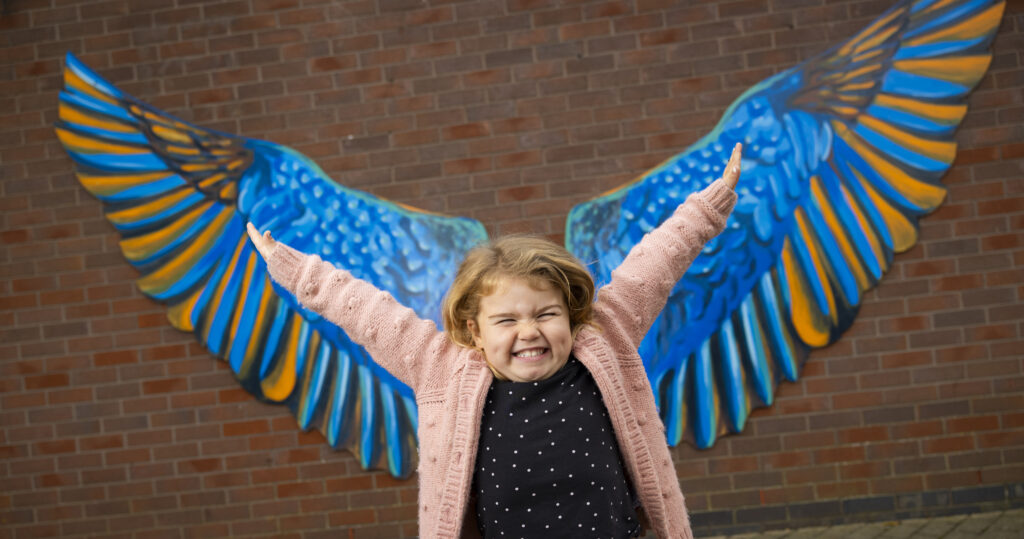
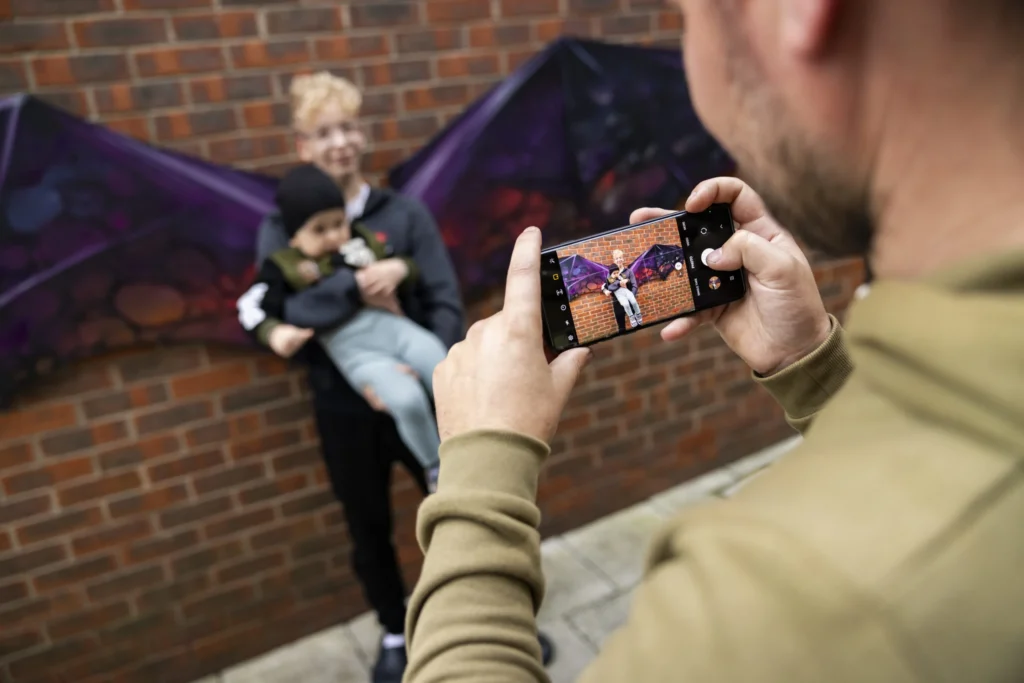
Take your photo with the wings along the Flyway Trail and make sure to share with us! #flywaytrail @transportedart
The Flyway Trail includes 16 artworks, installed in 2024 – split into two interlinking routes; a concentrated Boston-town trail and a district-wide trail in East Lindsey.
Inspired by birds, bats and insects found in our countryside and gardens and also at important nature reserves in Lincolnshire, the project aims to enhance locations with high-quality, interactive, human-scale artworks. They have been designed by a diverse group of artists experienced in public art, including local talent and nationally significant figures.
A ‘flyway’ is the flight path of migrating birds, referencing the importance of Local Nature Reserves as important resting points and destinations for many species, and links to wider themes for this project of journeys, home and safe havens.
The trail is designed to engage visitors and residents alike by creating a free, fun experience. You are encouraged to explore different sites, take a photograph with the wings, and share your experience on social media.
You can follow the QR codes to this webpage to find out where the other artworks are, to learn more about the species and find out what Lincolnshire has to be proud about!
Boston Area

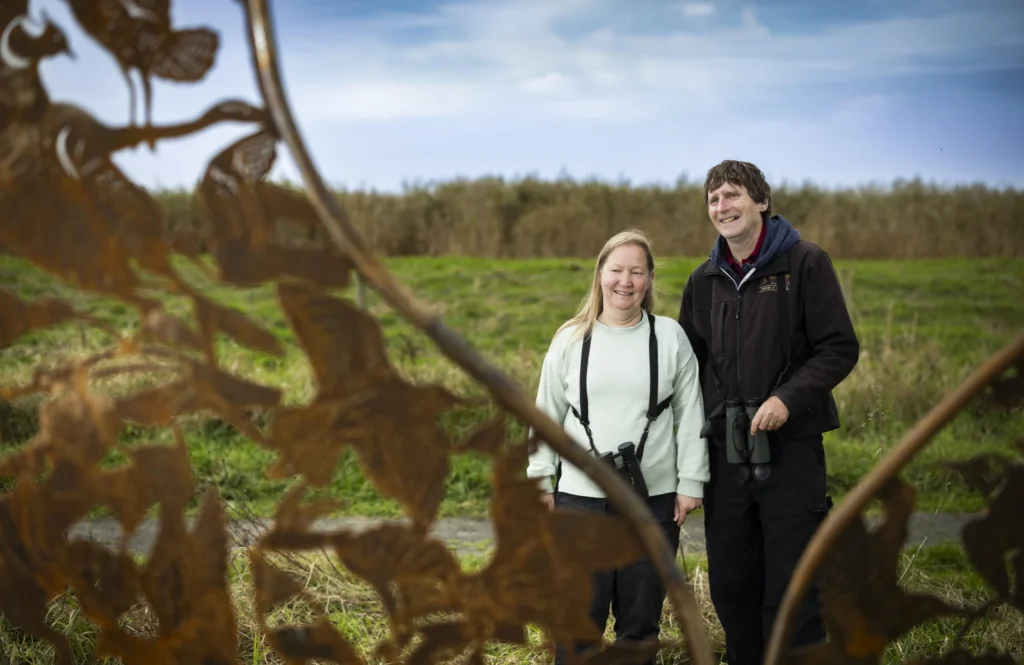
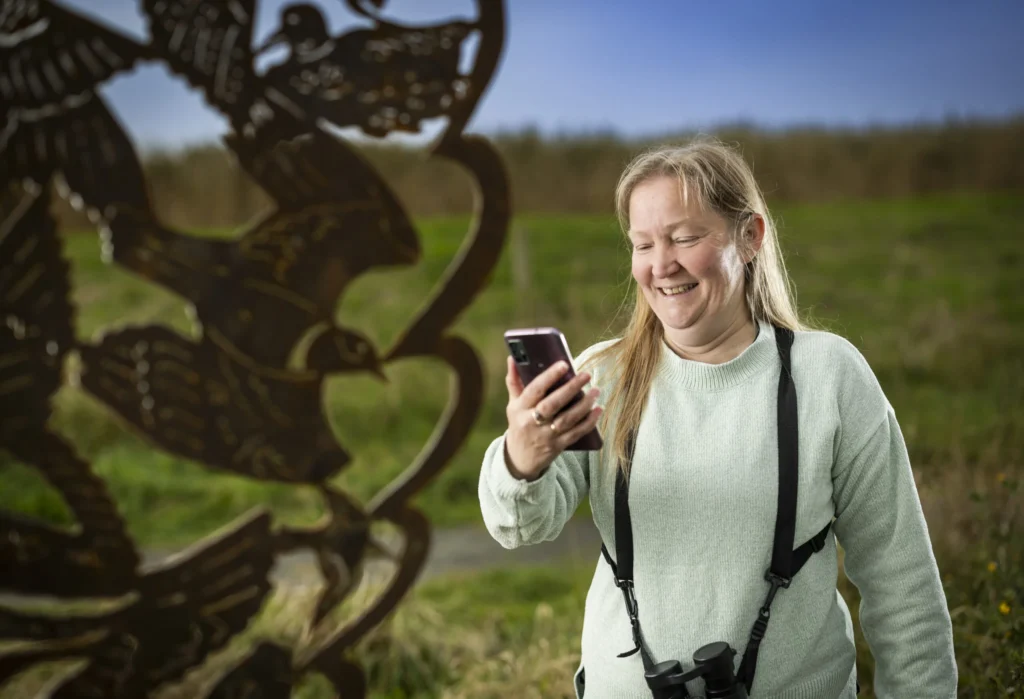

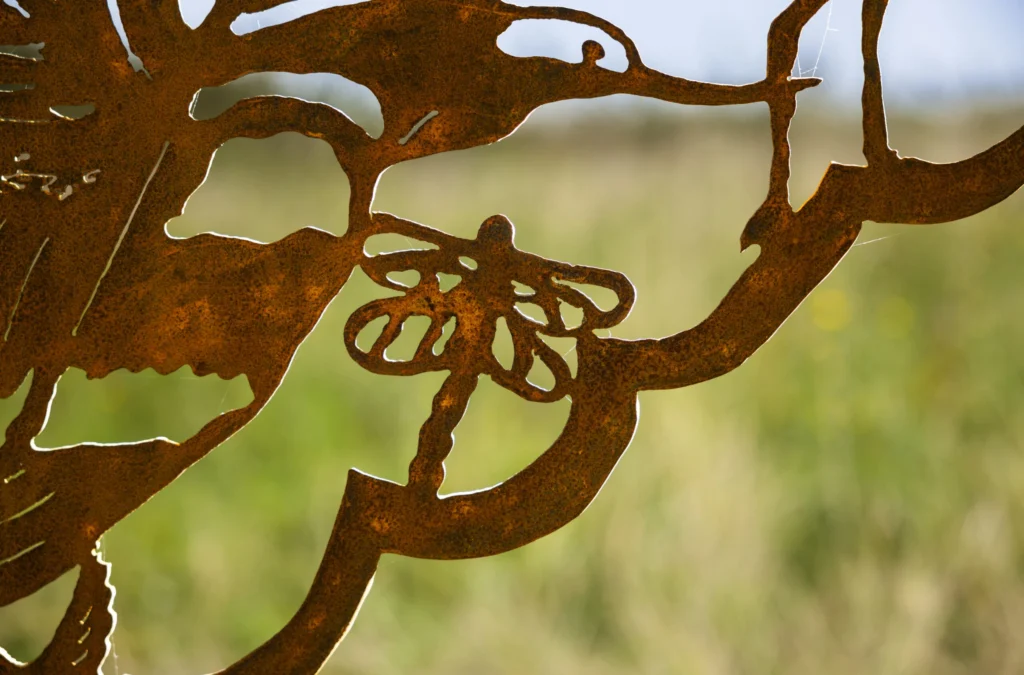
HAVEN at RSPB Frampton Marsh by Jeni Cairns
This artwork is halfway along the Reedbed Trail a RSPB Frampton Marsh, Roads Farmhouse, Frampton Roads, Boston PE20 1AY
Ask one of the helpful staff members for a reserve map if you need some help!
Haven is a freestanding wing-shaped sculpture, made from laser cut Corten steel.
To create the sculpture, Jeni spoke with the RSPB team to get an idea of the winged wildlife that live and thrive here, and then played with ideas on paper. The finished piece includes animal designs created by members of the public, who created drawings and prints in a workshop led by Jeni during the reserve’s 40th anniversary celebrations.
Of the process, Jeni said, ‘I’m really loving working on these pieces they have given me opportunities to expand my process and are a joy to make. I hope my pieces will connect people a bit more to the wonder of nature and thus help to develop love and care for our natural world.’
It depicts many native and migrating species found at the reserve – see if you can spot a lapwing, avocet, ringed plover, redshank, heron, egret, eider duck, pheasant, swallow, kingfisher, mallard, owl, redshank, butterfly and a dragonfly!
Just half a mile from the fabulous Haven sculpture is the reserve’s café offering light lunches, cakes, and hot drinks.
With views over the Reedbed Lagoon, it’s a unique stopping point – allowing you to get up close to nesting avocets in the spring, spoonbills feeding in the summer, and thousands of golden plovers swirling in the sky during the Winter, all while enjoying a delicious cake and cup of freshly ground coffee (no binoculars needed!). Visitors will also find Reflector an artwork designed by artist team cammdesign in 2015, which features sketches of birds by the local community.
RSPB Frampton Marsh’s magical mosaic of freshwater habitats lie five miles from Boston at the western edge of The Wash – England’s largest bay, a globally important estuary that’s a vital pitstop on the East Atlantic Flyway for migratory birds. It provides a safe haven for many native species such as redshank, avocet, and skylark including those affected by climate change, such as black-winged stilts, glossy ibis and spoonbill. There are over 100 wonderful volunteers here, working together to make RSPB Frampton Marsh such a special place for both people and wildlife.
There is plenty of car parking available, including accessible spaces. The Visitor Centre and cafeé are open 10am–4pm. During these hours the reserve has two free to hire mobility scooters. An outside toilet is available dawn till dusk. There are three walking trails here at RSPB Frampton Marsh, a one-mile, two-mile, and three-mile route.
Find out more about RSPB Frampton Marsh here:
https://www.rspb.org.uk/days-out/reserves/frampton-marsh
The RSPB team said, ‘We’re so excited to work with our friends at Transported again creating the new Flyway Trail piece ‘Haven’. Having previously partnered with Transported to deliver three amazing installations connecting people with art and nature, when the opportunity came up to host a piece designed and created by Jeni Cairns it was one, we weren’t going to pass up! Jeni’s intricate metal work, combined with a love of birds was a match made in heaven, or rather, Haven! We are delighted to be part of the Flyway Trail. It’s a fabulous opportunity to show off and celebrate the globally significant spectacle of wildlife we have here on the Lincolnshire coast, and to be part of a local network of nature themed artworks.’
Make sure to share your pictures with us and Frampton Marsh! @RSPBFrampton on X and @RSPB Frampton Marsh on Facebook.
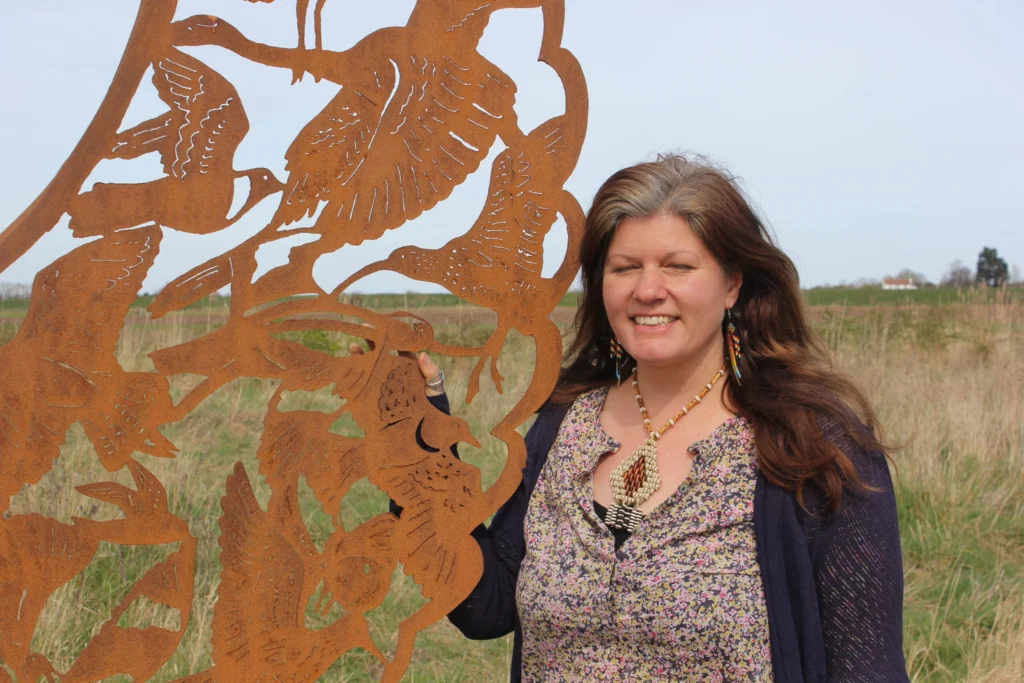
Jeni Cairns is an award-winning artist and garden designer living in rural Cambridgeshire. Her work covers a wide variety of mediums and disciplines including metal work, painting, collage, sculpture, drawing, garden design and planting. She studied Art & Design at Isle of Ely college and Fine Art at Derby University.

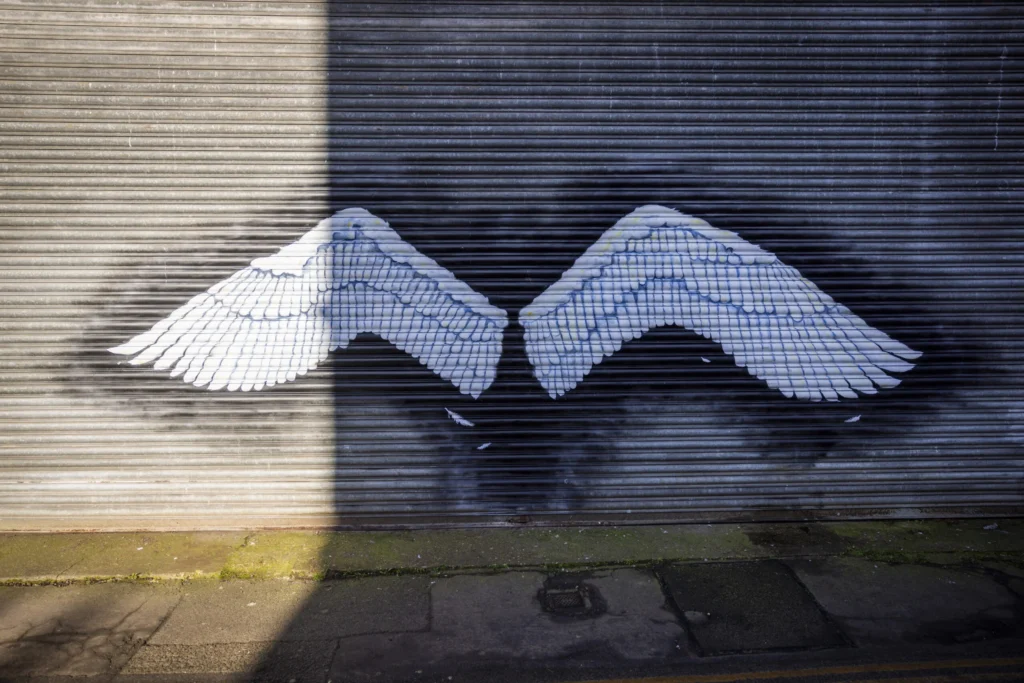

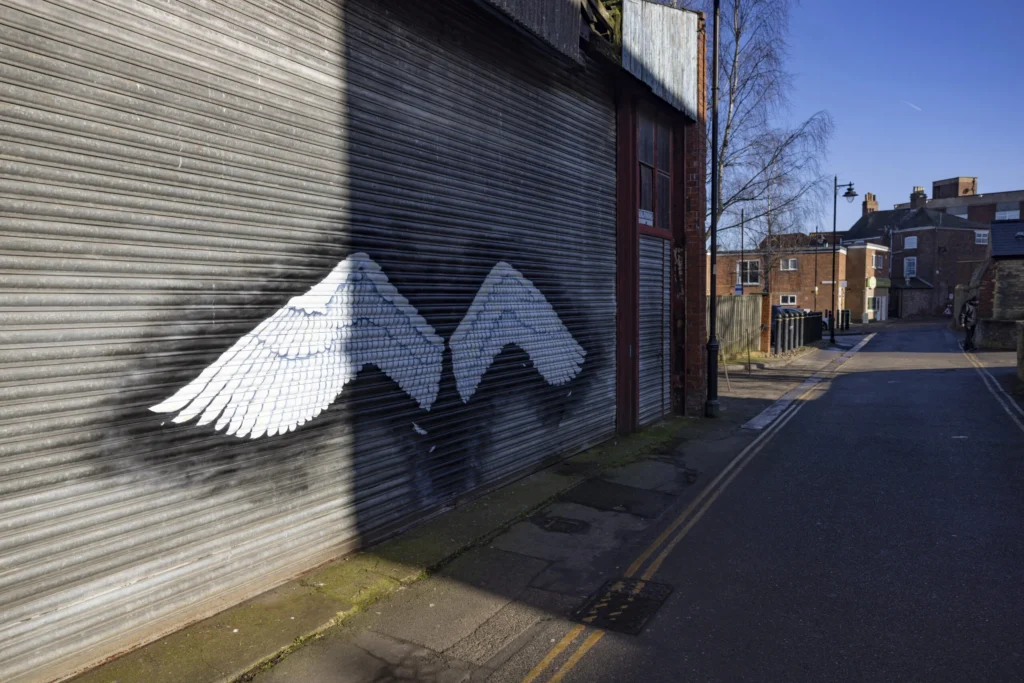
WHOOPER SWAN at Fountain Lane by Jane Kay
You can find this artwork on the large, corrugated metal door next to the pay & display car park. 13 Fountain Lane, Boston, PE21 6NR
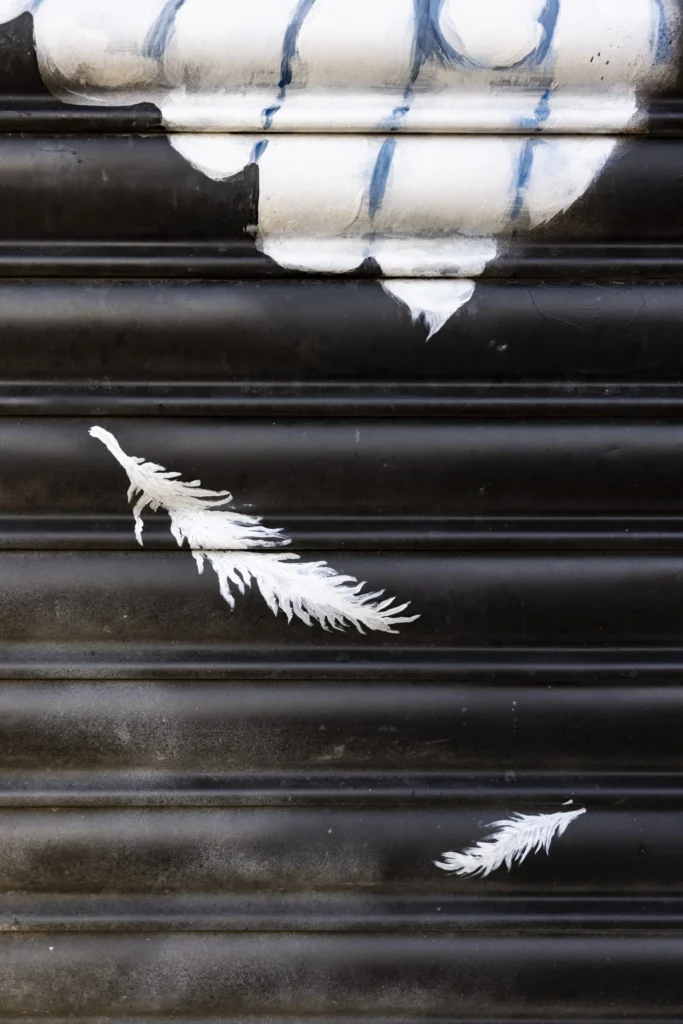
The Whooper Swan is painted directly on to the roller door and depicts large white whooper swan’s wings.
This species is a little smaller than the mute swan (the UK’s most common swan). The whooper swan has a long neck, which it usually holds erect, black legs and a black bill has a large triangular yellow patch. It is mainly a winter visitor, flying down from Iceland, although a small number of pairs nest in the north of the UK. The estuaries and wetlands along the Lincolnshire coast are vital to its survival. Its winter population and small breeding numbers here put it on the ‘Amber List’, as there are conservation concerns for the species. It is also a Schedule 1 listed bird, meaning it is illegal to disturb them.
Whooper swans were known to the ancients in the far north as symbols of summer, as the weather would become warmer when the swans returned. The swan often represents elegance, beauty, grace and purity, but also holds incredible strength, which is almost always channelled for the protection of their young. Swans mate for life and are devoted partners and parents.
Fairytales from around the world feature swans – “Swan Maiden,” a young woman who transforms into a swan whenever she wears a cloak of swan feathers, “The Wild Swans” – a fairy tale about cursed brothers who are saved by their sister and of course the doomed love story of “Swan Lake”.
The artist researched this symbolism of the swan; transformation and rebirth resonated particularly, as well as their devotion to family.
Fountain Lane is very centrally located in Boston, with lots of independent and national chain restaurants and cafes, and the historic St Botolph’s nearby to explore.
Jane Kay was born in Boston ‘with a roll of paper and a pencil in my hand’. She studied at Lincoln College of Art, followed by Leeds and Goldsmiths, London, and went on to teach art for almost 35 years. Since retiring and returning to Boston, Jane has become an expert woodcarver and mosaic specialist and has always stayed true to her first love of drawing and painting.
Of being involved in the Flyway Trail project, Jane said, ‘I feel privileged to have been afforded the opportunity to do this in my hometown. There is power in the flapping of the tiniest wing. By communicating and pulling together we can elicit a positive impact on the environment.’
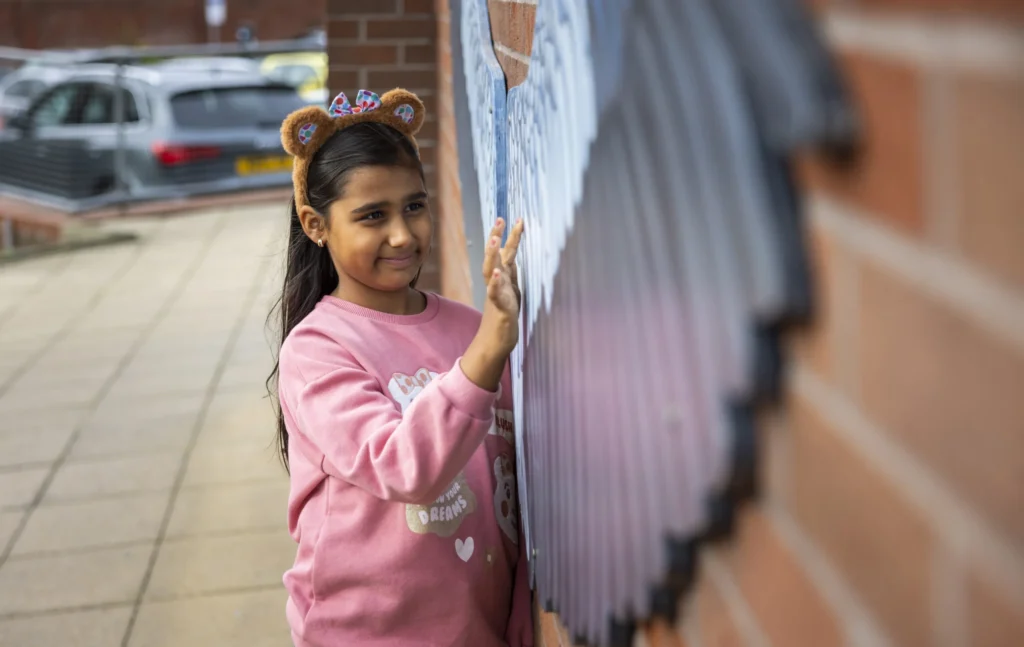
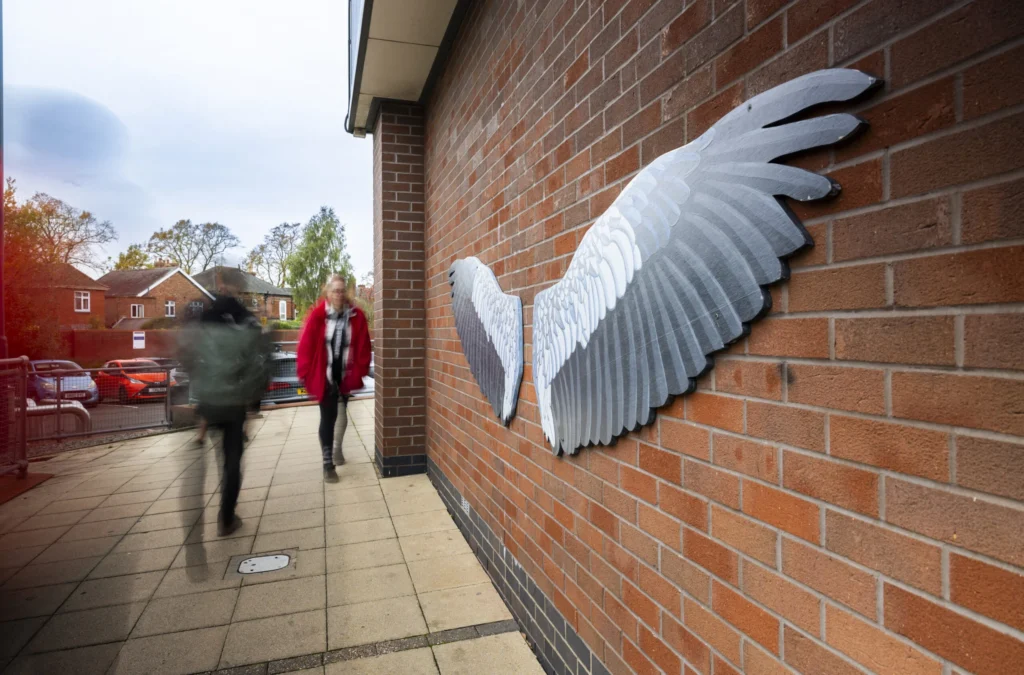
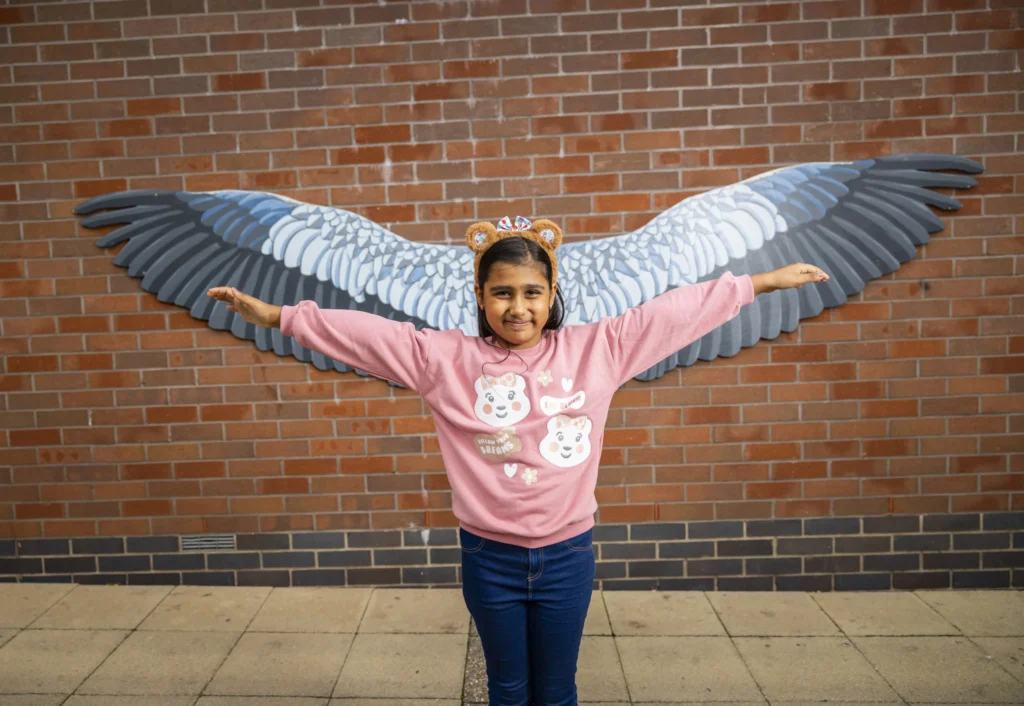
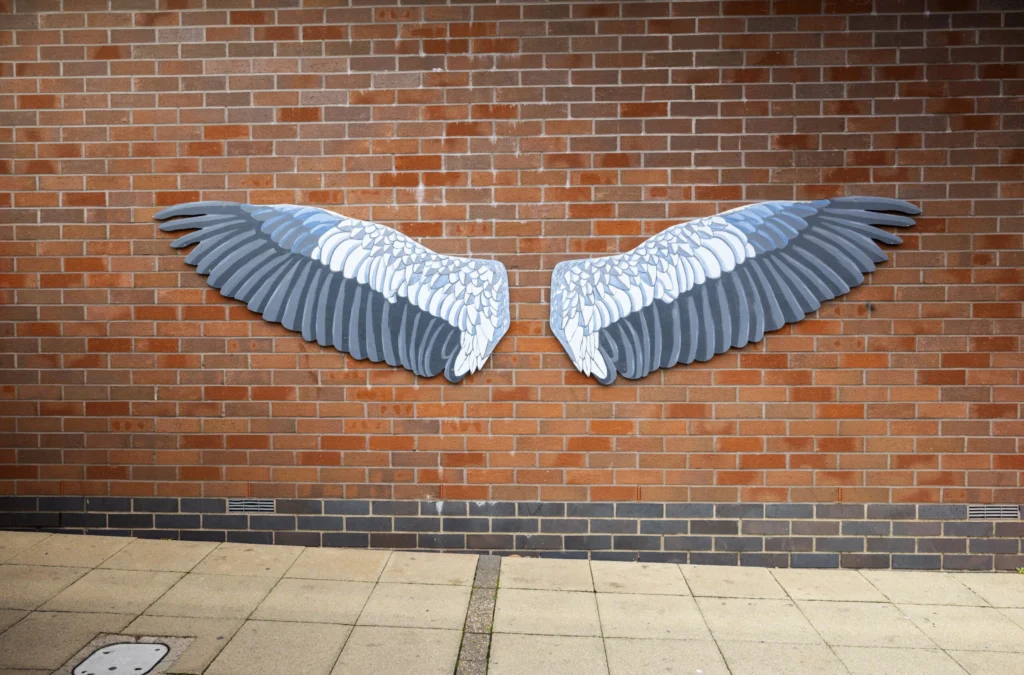

GREY HERON at Boston Shopping Park by Ellie Benton
Located at the far end of the walkway entrance (opposite Bargate Roundabout), on the side of TK Maxx. Boston Shopping Park, Horncastle Rd, Boston PE21 9BN
This artwork is a pair of grey heron wings painted on to wing-shaped marine ply panels fixed to the brick wall.
Grey herons are unmistakeable – tall, with long legs, a long beak and grey, black and white feathers. They can be spotted along the Maud Foster Drain, standing with their neck stretched out, looking for food, or hunched down and all tucked in. These birds spend much of their time alone, feeding mainly on fish but can be tempted by the occasional tasty mole! When feeling particularly lazy the heron will even visit garden ponds for a quick and easy snack.
Make sure to look out for these incredible birds in flight, their slow-flapping wings and long legs held out behind make them hard to miss! They can be found throughout towns and countryside, on canals, ponds, lakes and rivers across the UK.
Boston Shopping Park is very accessible, with a 325-space car park, approximately two minutes’ walk from the town centre.
Parking is available on site. The nearest public toilets are at the Cattle Market car park approximately 3-5 min walk away, where also you will find a cafe.

Ellie Benton, an artist from Lincolnshire, uses painting to explore the realms of human connection, giving form to emotions and experiences that are often beyond words. Ellie grew up surrounded by musicians and dancers, which has greatly influenced her work. She strives to capture some of the magic she experienced as a child. Her works serves as an invitation to step into a world of vivid colours and celebrate the human spirit through play. She is also heavily inspired by the natural world, bringing life and colour to birds and landscapes, demonstrating her love of life!
Of her process, Ellie said ‘My work is a continuous evolution shaped by experimentation and play. I love working on a large scale, allowing the movement of my body to guide the composition organically. Often, I incorporate natural found objects as tools to apply paint and embrace the elements by painting outdoors, inviting unpredictability into my process’.

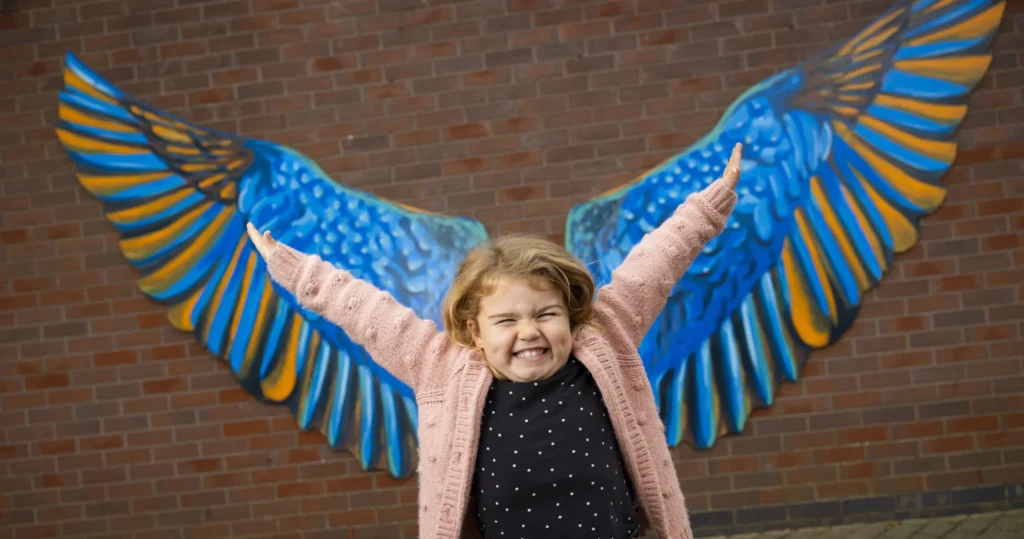
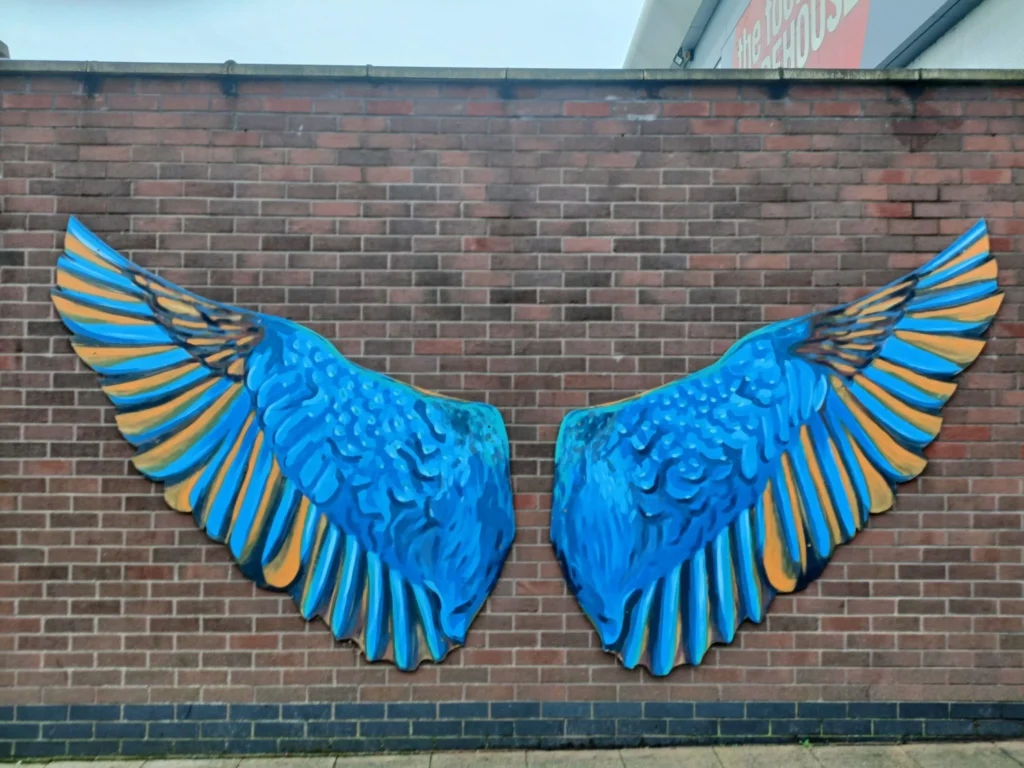

KINGFISHER at Boston Shopping Park by Ellie Benton
Located just after the entrance to the car park, on the wall before The Food Warehouse at Boston Shopping Park, Horncastle Rd, Boston PE21 9BN
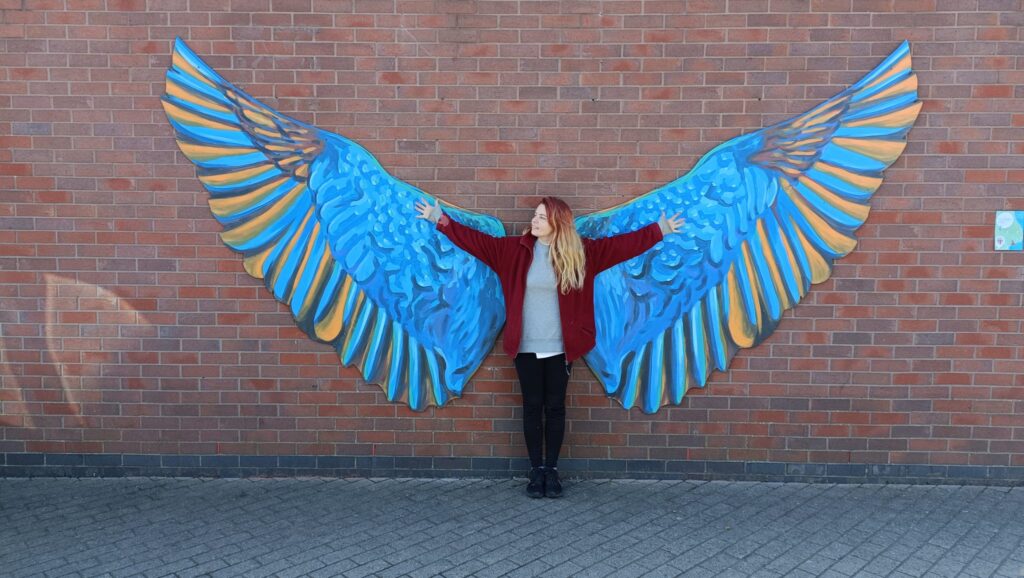
This artwork is a pair of kingfisher wings painted on shaped marine ply panels fixed to the brick wall.
Blink and you may miss the fantastic kingfisher! The kingfisher is a colourful bird of rivers and streams and is easy to recognise due to its bright blue and metallic copper colours. It darts along the riverbank or sits patiently on a low branch over the water, watching and waiting, then suddenly diving in to catch a small fish.
Kingfishers live in burrow-like nests near lakes and other waterways. They’re vulnerable to hard winters and habitat loss through pollution and poor management of waterways. They are also listed as a Schedule 1 species under the Wildlife and Countryside Act, offering them additional protection.
Ellie has painted two sets of birds’ wings in this location, make sure you have found both of them!
Boston Shopping Park is very accessible, with a 325-space car park, approximately two minutes’ walk from the town centre.
Parking is available on site. The nearest public toilets are at the Cattle Market car park approximately 3-5 min walk away, where also you will find a cafe.
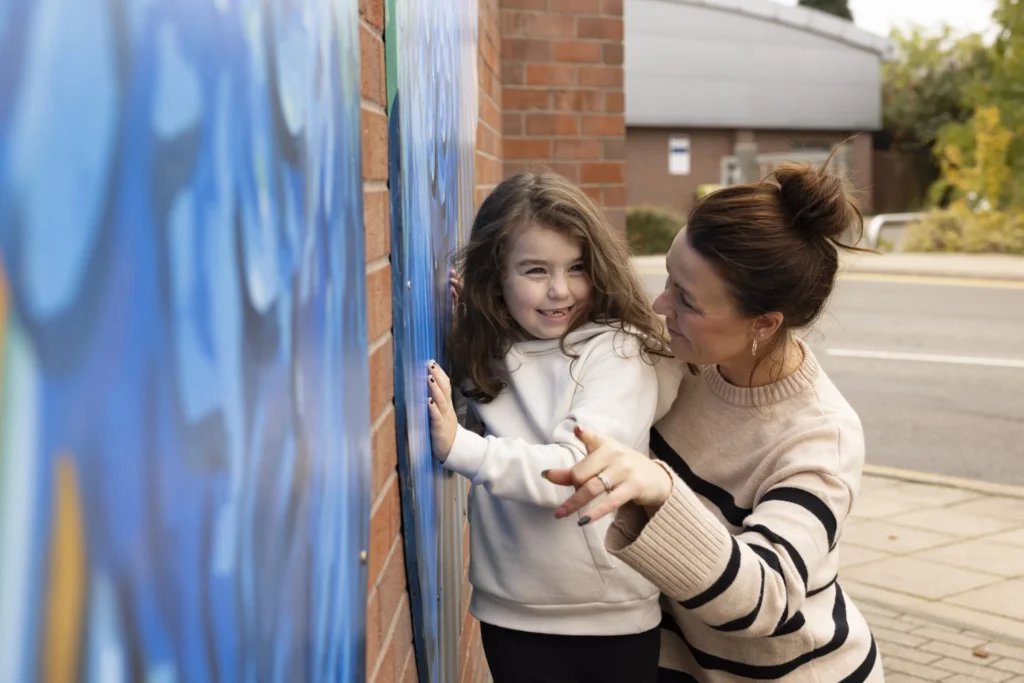
As part of the creative programme of activities connected to the Flyway Trail project, Ellie delivered a free drop-in workshop in the Boston Market Place where the public were invited to make wonderful colourful creations under Ellie’s guidance. Participants explored their artistic side and connected with their community whilst contributing to the vibrant tapestry of The Flyway Trail in the session by creating feathers using Ellie’s templates and decorating with paint and pastels.
Ellie said ‘Fortunately, my neighbour had a wealth of books on birds, which proved invaluable during the design process. I used the diagrams to help design the wings for the Flyway Trail, ensuring they were both recognisable and a true celebration of the birds depicted.’

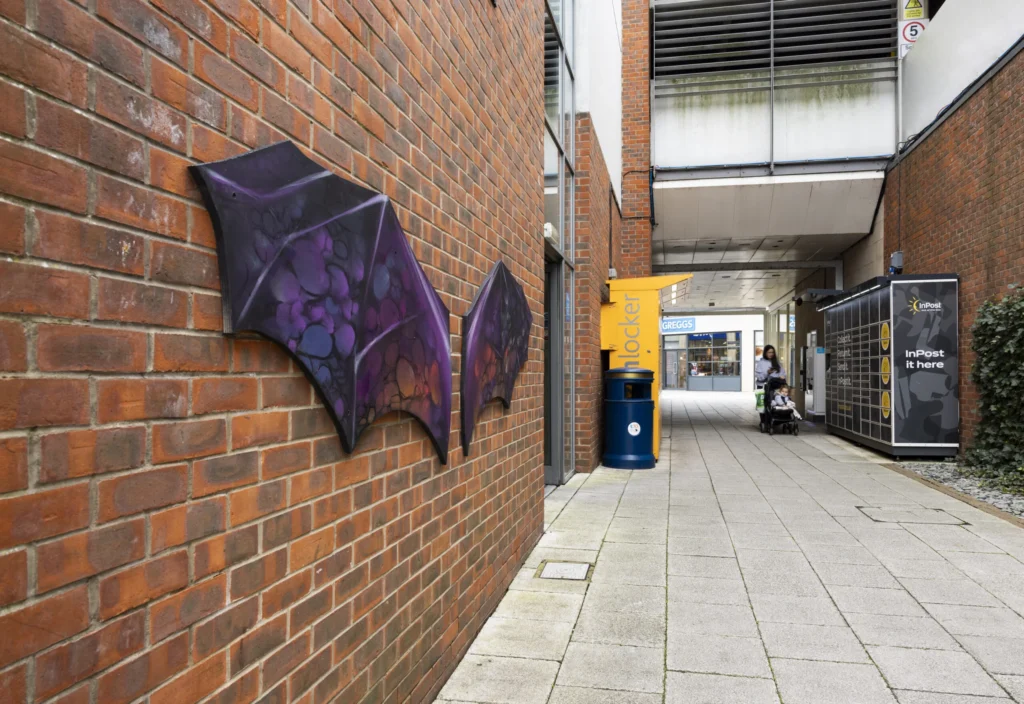
PIPISTRELLE BAT at Pescod Square by GRAFFWERK
Head through the walkway next to Bonmarché, in the direction of the Management Office; located just past the Amazon lockers on the right. Pescod Square, Boston, PE21 6QX
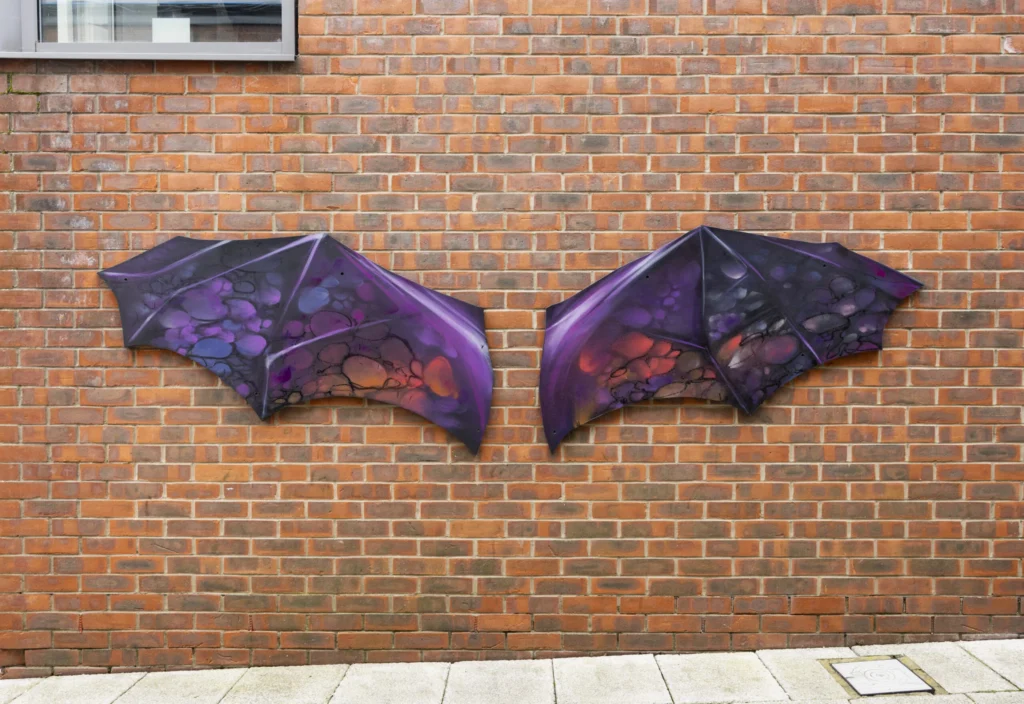
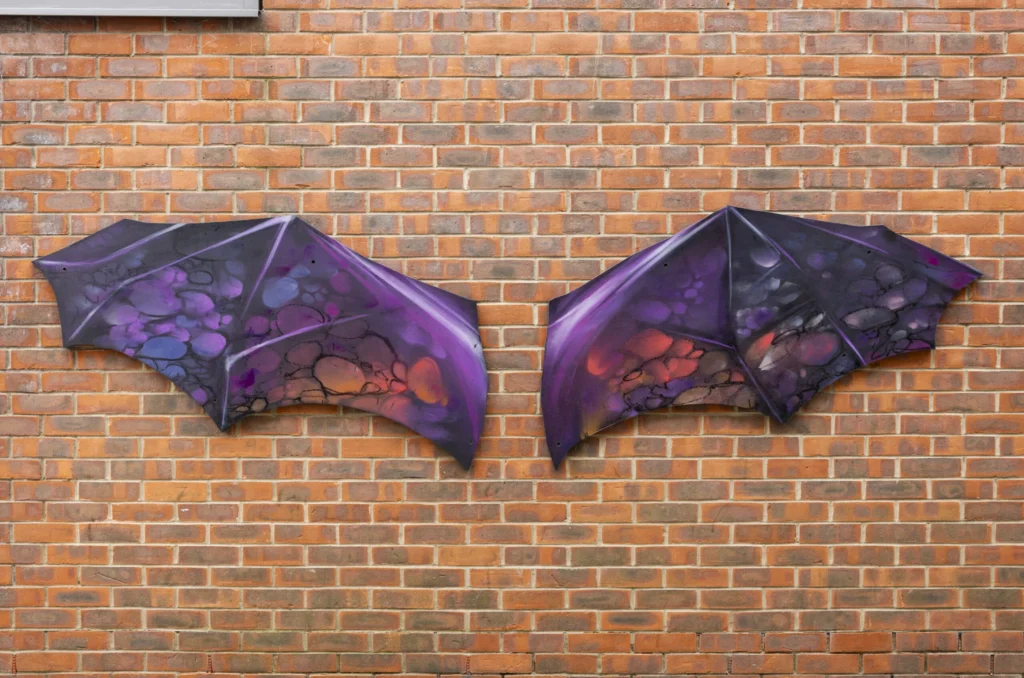
This artwork features a pair of pipistrelle bat wings painted onto shaped marine ply panels fixed to the brick wall.
The common pipistrelle is one of the most widespread British bats. It weighs around 5 grams (like a 20p piece) and is so small, it can fit into a matchbox! Despite its size, it can easily eat 3,000 insects a night. Look for it flitting around the garden or a lit lamp post as it chases its prey.
Common pipistrelles feed in a wide range of habitats including woodland, hedgerows, grassland, farmland and urban areas. They generally emerge from their roost around 20 minutes after sunset and fly in fast, jerky moves between 2-10m above ground level searching for their insect prey.
Summer roosts of common pipistrelles are usually found in crevices around the outside of buildings. They can be found behind hanging tiles, soffit and barge or eaves boarding, between roofing felt and roof tiles or in cavity walls.
Pescod Square is an external shopping centre with an adjacent car park, which includes 14 Blue Badge parking spaces. The centre includes high street favourites including Waterstones, Next and and Greggs as well as local independent retailers.
This species was selected for this site at Pescod Square as they used to live in the old hall. The area is named after the Pescod family, notable merchants in in the town. Pescod Hall dates from about 1450. It is timber-framed with brick infilling, which was taken down and rebuilt in 1974.
GRAFFWERK is a versatile arts project team led by Anthony Overend and Izzy Peacock. GRAFFWERK aims to redefine the visual landscape of towns and cities through the use of street art. Artist management, educational provision, project management alongside various social improvement activities are among the services the team offers. They are also responsible for the award winning Bring The Paint Festival, an international celebration of street art taking place every two years.
They said, ‘As keen hikers ourselves it’s brilliant to be involved with The Flyway Trail and similar projects that encourage people to get outdoors, exercise and learn about their natural environment.’
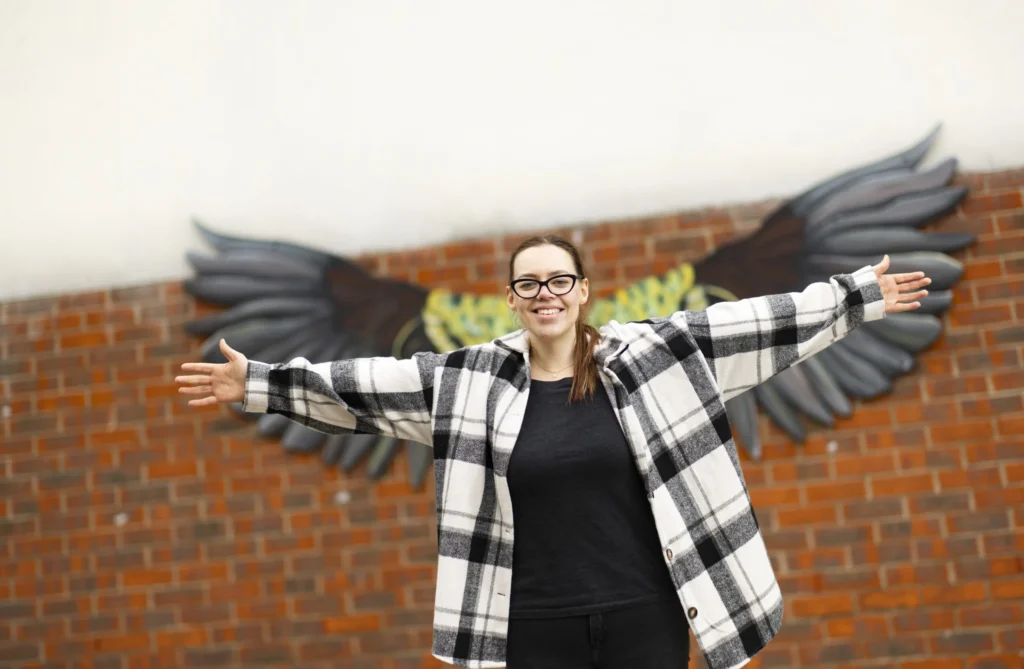
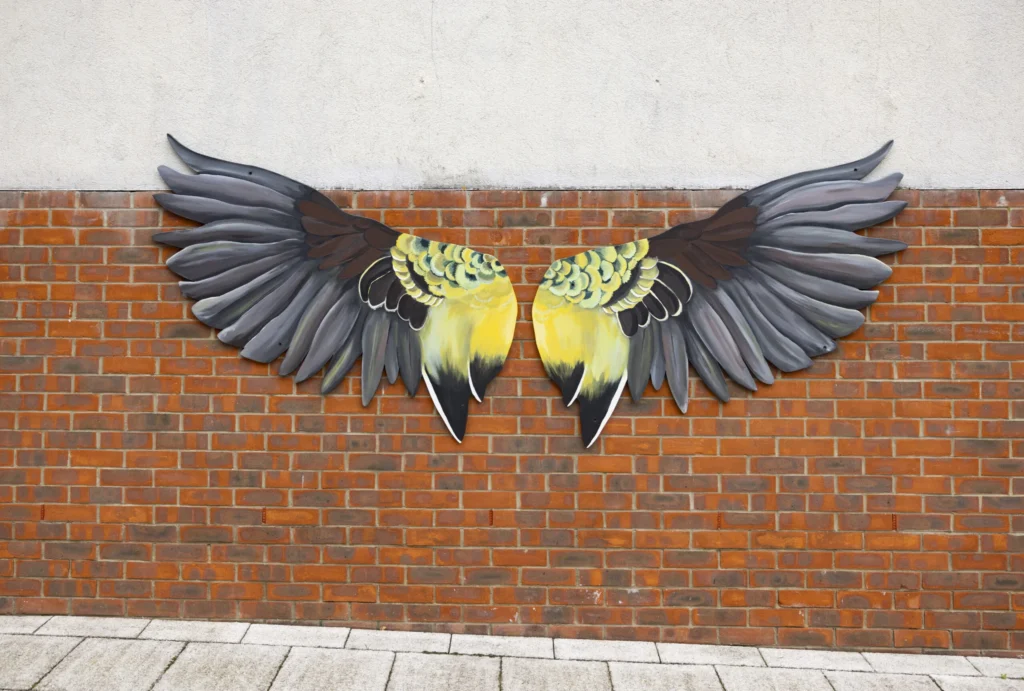

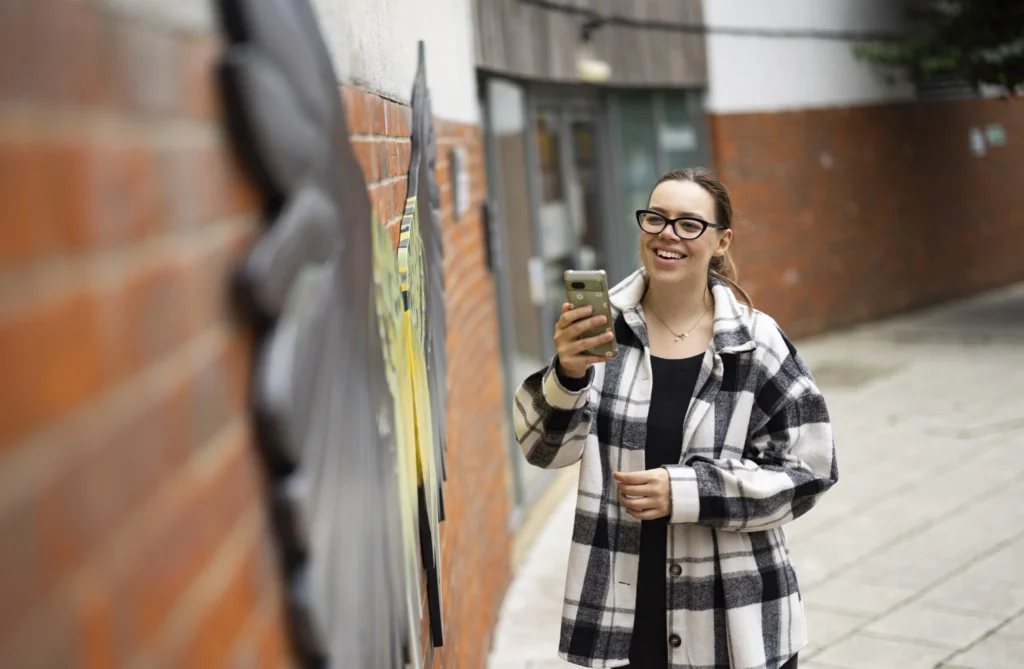
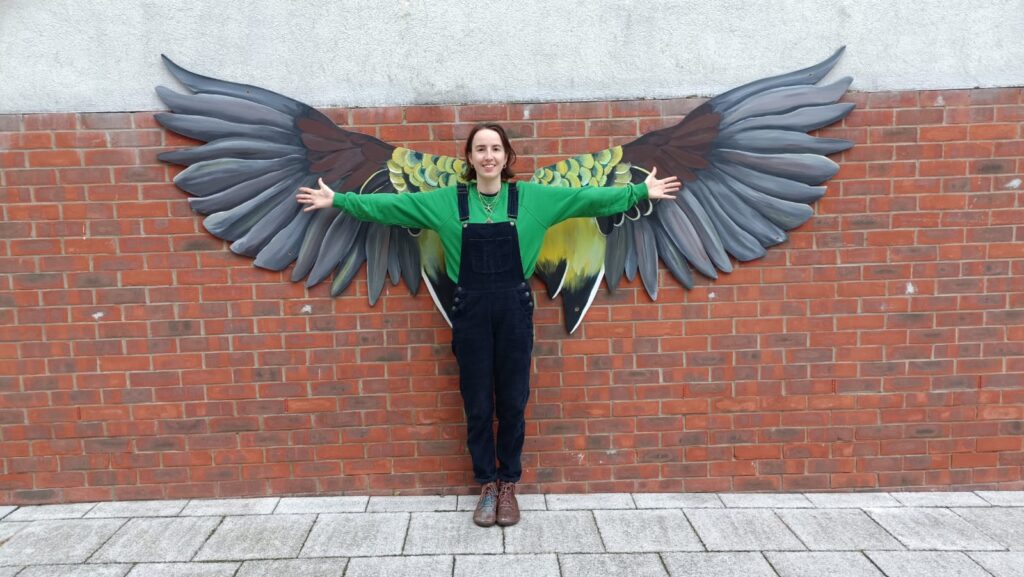
YELLOW WAGTAIL at Pescod Square by Emily Bowers
Head through the walkway next to Bonmarché, in the direction of the Management Office; located on the left just before the Management Office. Pescod Square, Boston, PE21 6QX
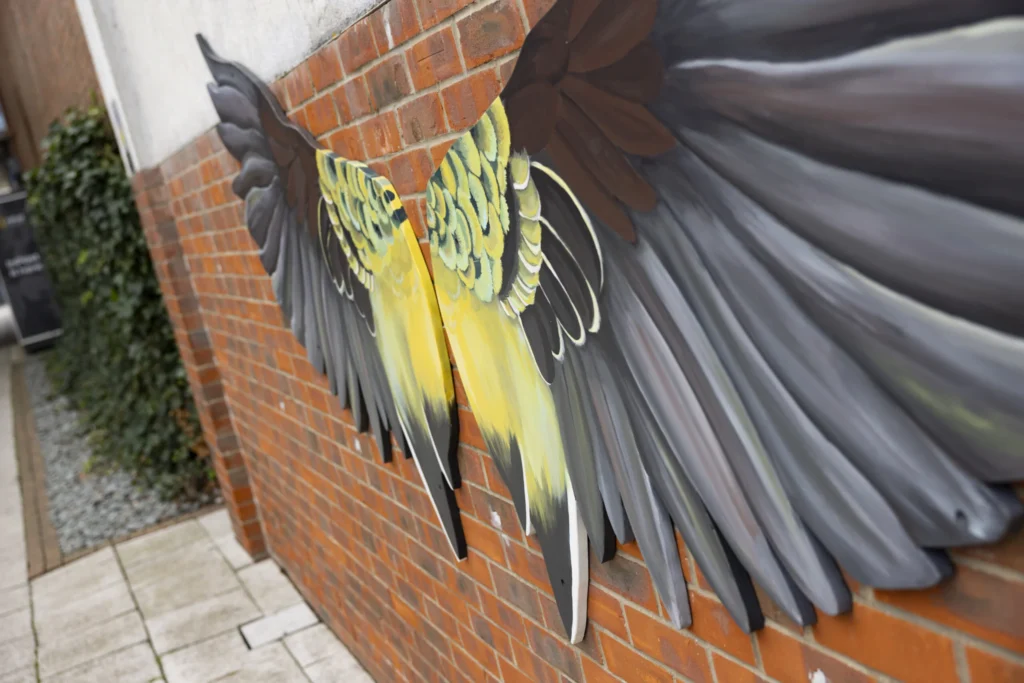
This artwork is a pair of yellow wagtail wings painted onto shaped marine ply panels fixed to the brick wall.
he yellow wagtail is a small, graceful, yellow and green bird, with a medium-length tail and slender black legs. It spends much time walking or running on the ground. As its name implies, it wags its tail from time to time. It’s a summer visitor to the UK, migrating to winter in Africa. It breeds in a variety of habitats, including arable farmland, wet pastures and upland hay meadows. Serious declines in breeding numbers across all of these habitats place the yellow wagtail on the Red List of birds of conservation concern. They can be found at RSPB Frampton, Freiston Shore and other nature sites along the Lincolnshire Coast.
When talking about the process to create this artwork, Ellie said, ‘For the yellow wagtail, it was important to communicate an element of accuracy, so I started by studying reference images of the birds in flight at different angles and began piecing the feather groupings together by drawing them in my sketchbook – I was lucky to spot and watch one at Frampton Marsh too! Its feathers are more vibrant on the outside of the wing, which is shown here’.
Pescod Square is an external shopping centre with an adjacent car park, which includes 14 Blue Badge parking spaces. The centre includes high street favourites including Waterstones, Next and and Greggs as well as local independent retailers.
Emily is an artist who is deeply inspired by the natural world and our connection to it. Through her work, she hopes to create conversation and engage people in the arts.
Emily’s approach is experimental, tuning into emotions and body movement when creating. Colour, light, texture and atmosphere are all strong contenders in her work. She strongly believes in inspiring creative confidence in others.
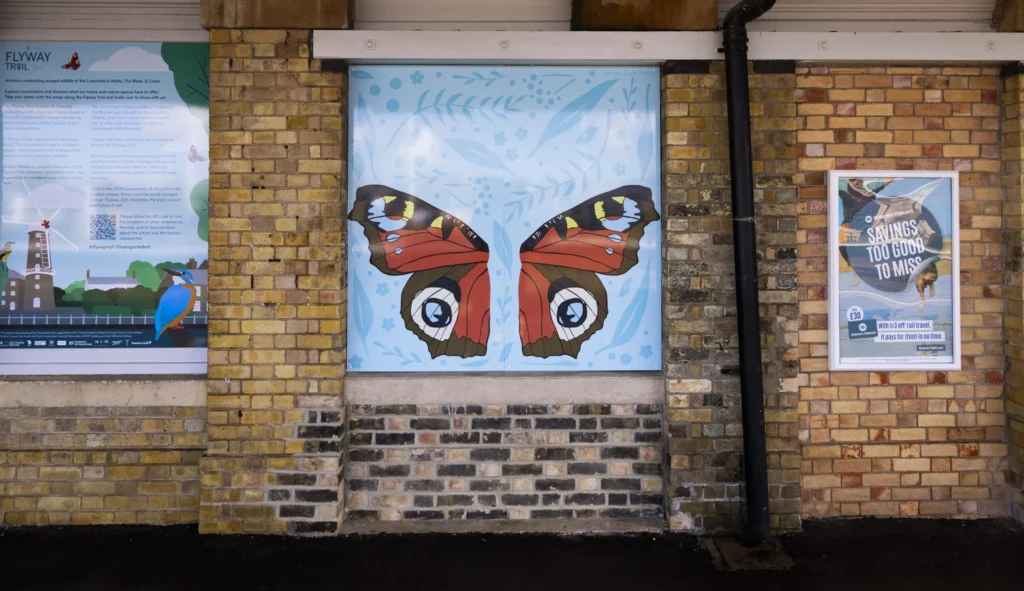

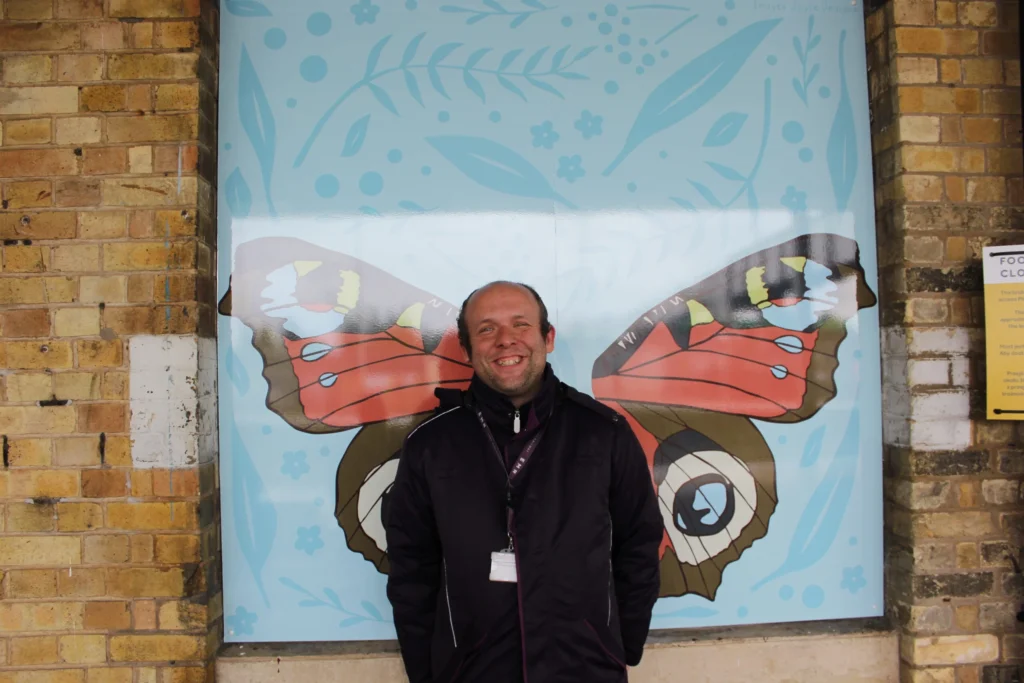
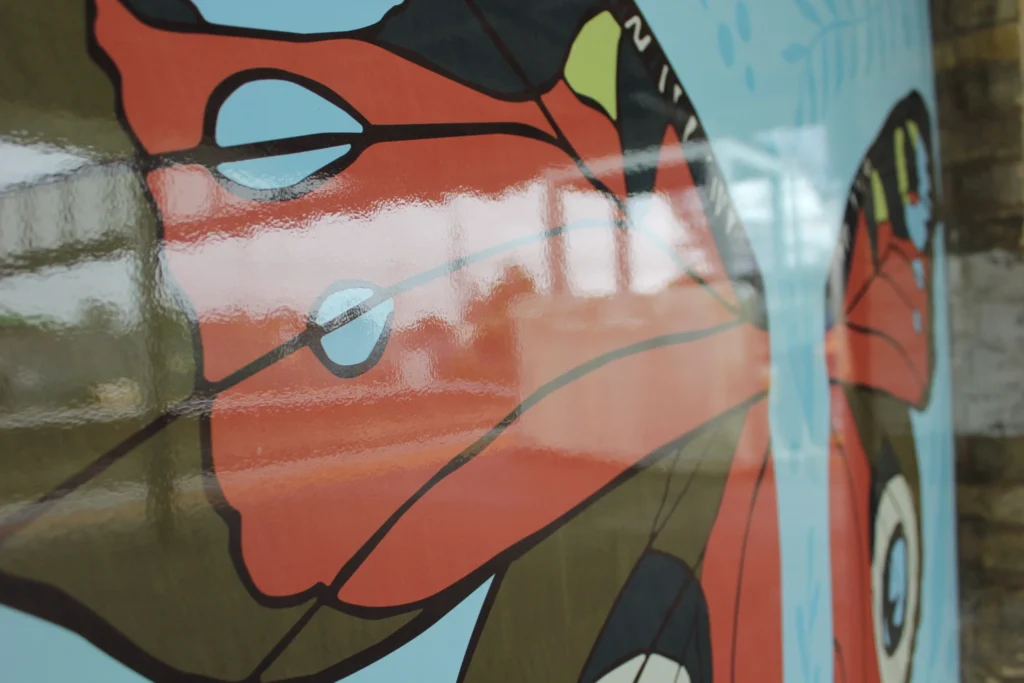
PEACOCK BUTTERFLY at Boston Train Station by Imogen Joyce Designs
To find this artwork, head to Platform 1, and find it on the wall of the ticket hall. Boston Station, Station Approach, Boston, PE21 8RN
Peacock Butterfly is a digital illustration, printed on to dibond aluminium panels fixed to the wall.
The artist, Imogen Joyce, began her research in her own garden, noticing the butterflies and how they interacted with plants and the space around us. She spent some time sketching butterflies to understand their shape and form and all the beautiful colours that form a part of their wings.
For the project, Imogen also created a pack of free colouring-in sheets, featuring some of the creatures that have inspired the artwork on the Trail. Download them for free.
This is perhaps one of our most loved and easily recognisable British butterflies. It is strikingly beautiful and named for the large blue and yellow ‘eyes’ on each upper wing that resemble the tail feathers of a peacock.
It is present throughout the year, lays a single brood of eggs, and overwinters as an adult. A very common butterfly, the peacock is a regular visitor to our gardens where it loves to feed on nectar from buddleia and other plants including thistles, bluebells and dandelions.
It is widespread in the UK and can also be found in fields, woodlands and coastal areas. The caterpillars, which are jet black, velvety and covered in tiny white spots and short shiny black spines feed on common nettles.
Boston station is the only rail hub in the Lincolnshire town and serves around 200,000 passengers each year.
It is located just outside the town centre and is less than one mile away from the Blackfriars Theatre, Boston Guildhall and the town’s football stadium on York Street.
Just to the south of the station is Boston Docks. Trains to Boston operate from Nottingham (via Sleaford) to the west and the seaside resort of Skegness to the north-west.
The first railway in the town opened in the 1840s and for a period it was possible to catch a train to Boston from as far away as London. However, since the 1960s the number of operating trains from Boston has fallen due to the opening of new northern line via Doncaster.
The outside of the station has retained its Victorian style and features a number of distinctive stone arches.
Imogen is an illustrator, designer and storyteller based in the rural town of Stamford, Lincolnshire. She uses joyful colours and unique textures to create her illustrations. Each design takes inspiration from the small joys of everyday life and often depict scenes of nature. She is passionate about sharing the benefits of nature and the impacts it can have on mental and physical wellbeing.
‘I’m delighted to be a part of this project. It’s great to think that my piece of artwork forms a small part in a larger piece of work and it’s a lovely way to connect with local communities across Boston & East Lindsey.’

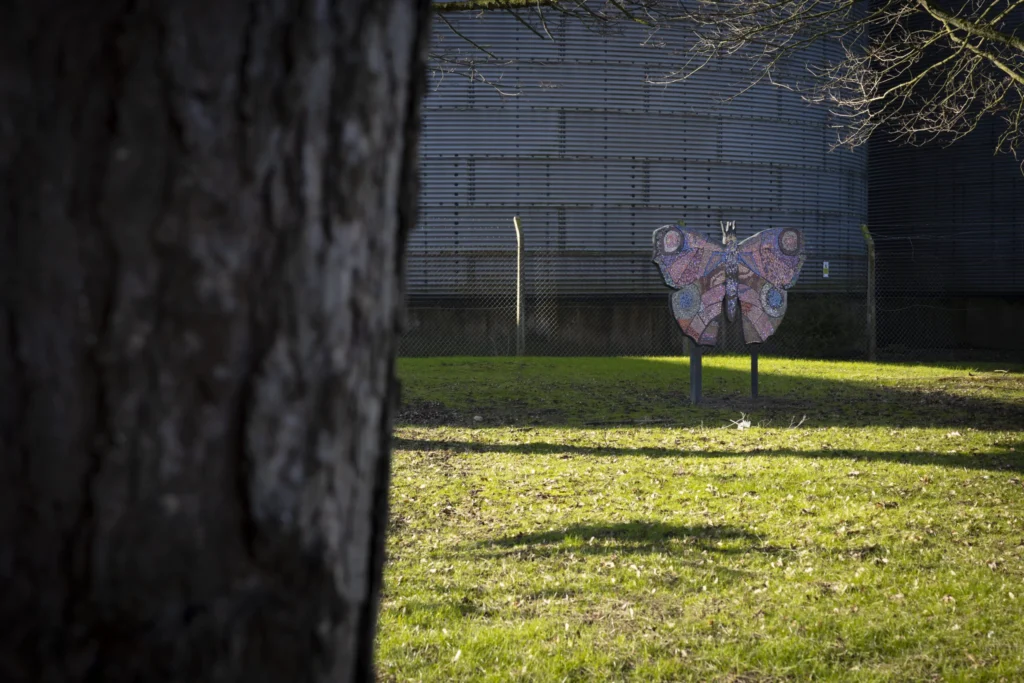
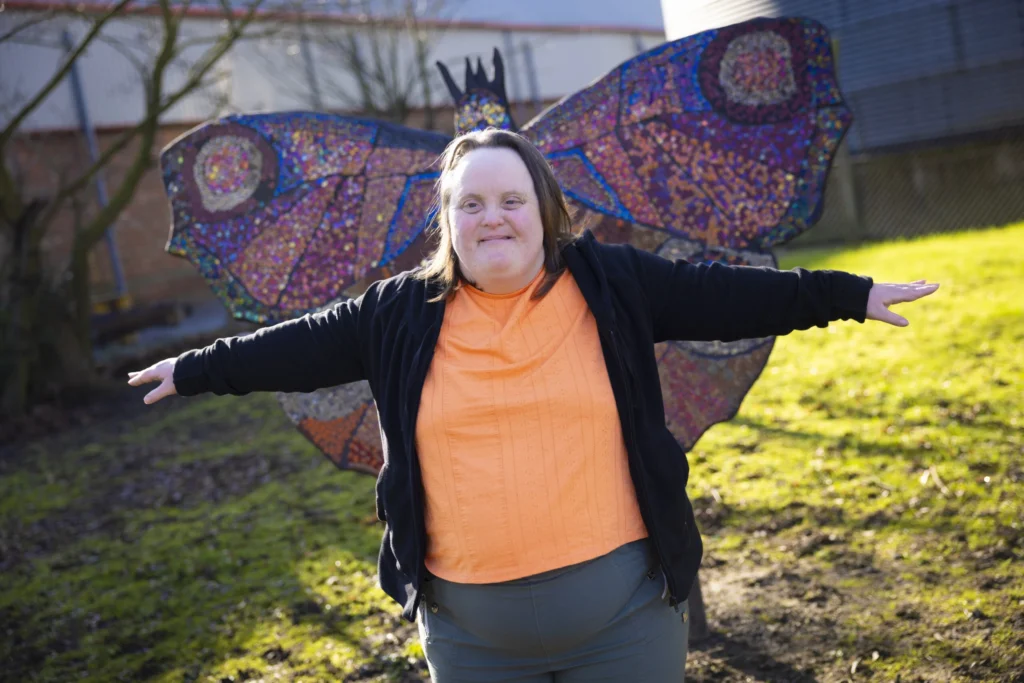
MOSAIC BUTTERFLY at Scott House by Jane Kay
You can find this artwork in the gardens of Scott House, 35 Skirbeck Road, Boston PE21 6DA.
Please note that Scott House and its grounds are only open during week days from 9am-4pm
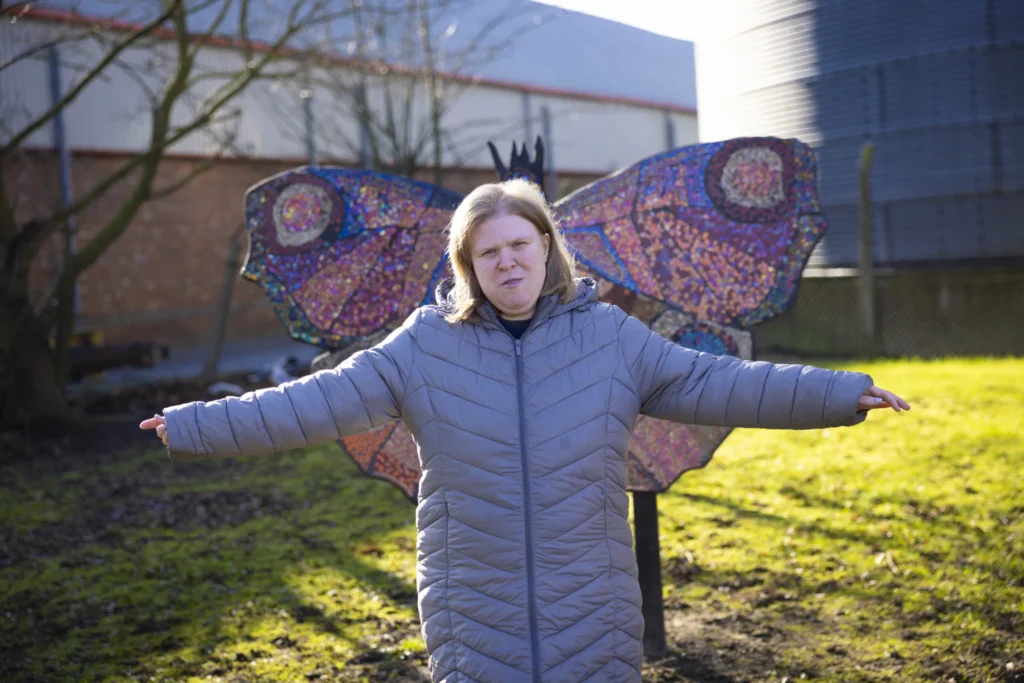
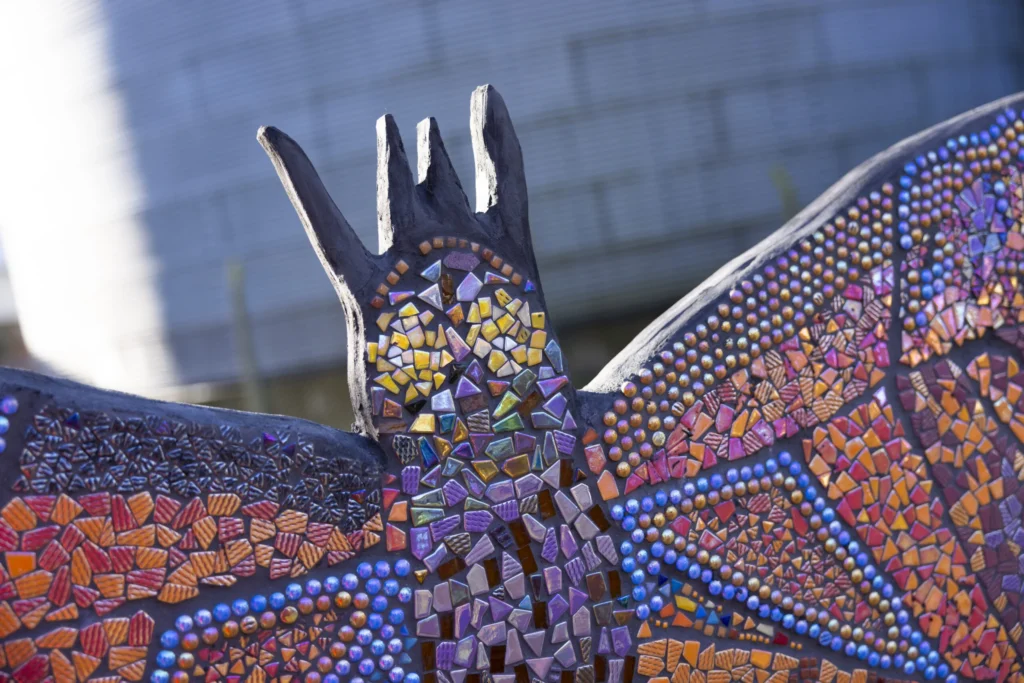
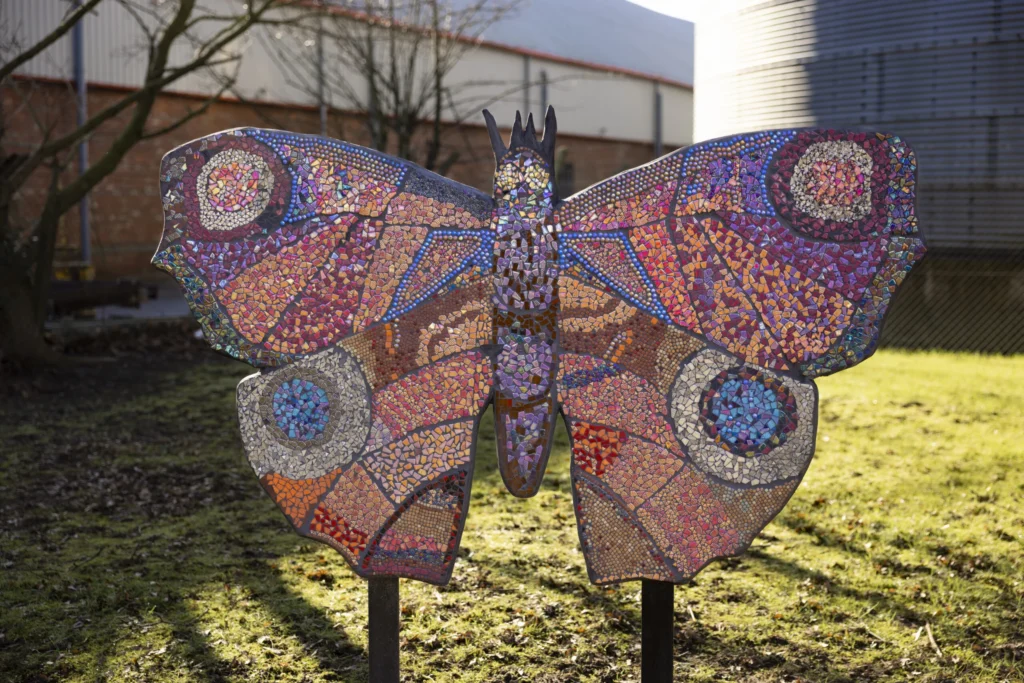
The Butterfly Mosaic is a large mosaic of a peacock butterfly.
This piece was created in collaboration with those that access Scott House in a series of free taster workshops in which the participants could have a go a creating their own designs with mosaic pieces and learn the principles of the craft.
A strikingly beautiful, red butterfly, so-named for the large blue and yellow ‘eyes’ on each upper wing that bare a marked resemblance to the tail feathers of a peacock.
It is on the wing throughout the year, having a single brood, and overwinters as an adult. A very common butterfly, the peacock is a regular visitor to our gardens where it feeds on buddleia and other flowers.
It ranges far, however, and can also be found in the shelter of woodland rides and clearings. The caterpillars feed on common nettles.
Scott House is a Lincolnshire County Council-managed day care centre. The friendly and knowledgeable team at Scott House is full of local knowledge and connections. Located within easy walking distance of the town centre, they are well-connected with various community groups and organisations and are an active part of the local community.
Focusing on the skills, talents, interests, and needs of each individual, their aim is to provide a range of meaningful and purposeful opportunities that help people maintain and develop new skills, try new things, and make a positive contribution to the town and community.
The building is fully accessible, featuring a large studio, a community café in development, cosy spaces, a large garden, a poly tunnel, and an allotment, creating a hub for the entire community.
Jane Kay is an experienced artist whose work spans across a variety of mediums, and she is a key member of the Boston School of Mosaics, a self-sustaining arts group.
East Lindsey Area
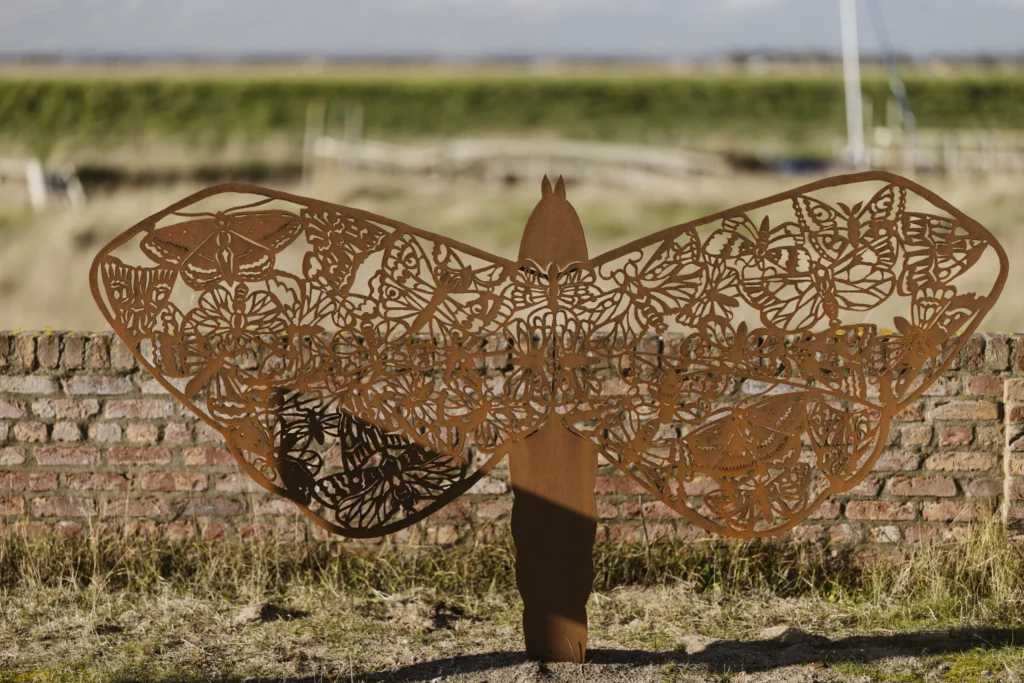

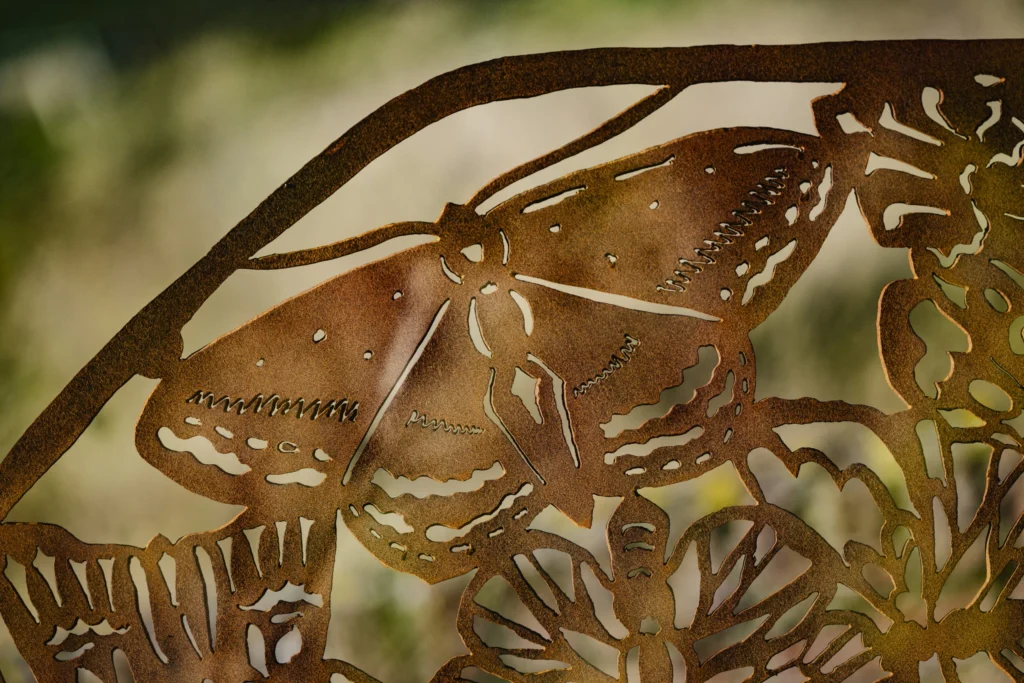
MOTHS at Gibraltar Point by Jeni Cairns
Located in the garden of the Old Coastguard Station, Gibraltar Point National Nature Reserve, Gibraltar Rd, Skegness PE24 4SU
Ask the welcoming staff in the Visitor Centre for some help if needed!><
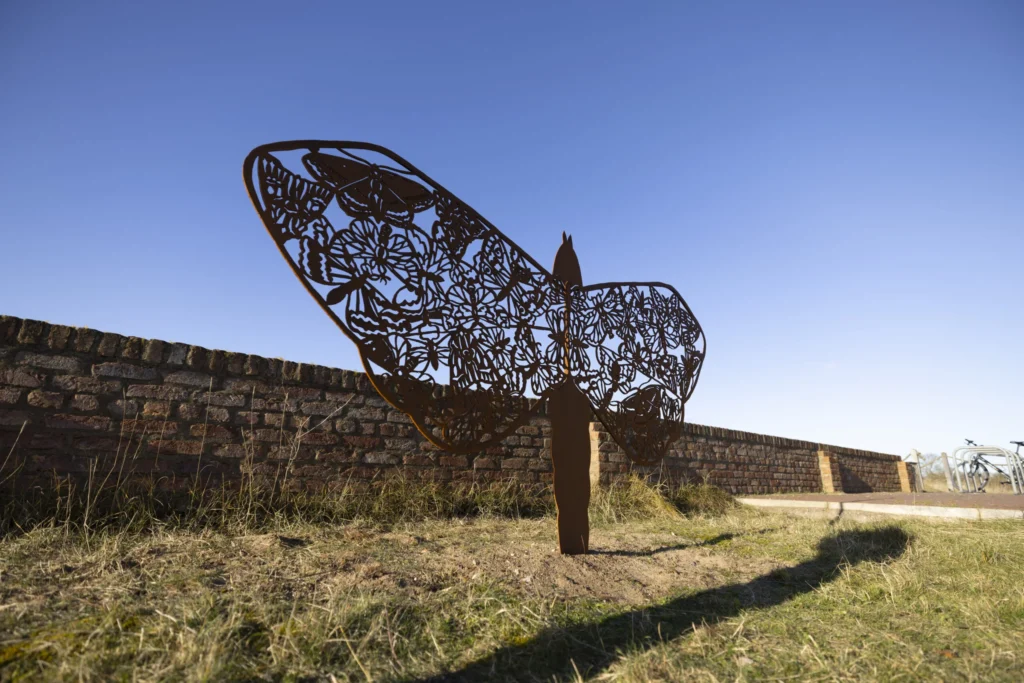
The freestanding metal artwork takes the shape of the star wort moth, and includes laser cut outlines of other moth species found on the Lincolnshire coastal dunes and salt marshes such as the marsh moth, starwort, coast dart, sand dart, dotted fanfoot, rosy wave, marbled clover, old lady and archers dart. The marsh moth is a particularly rare species, found only on the Lincolnshire Coast.
Moths are often dismissed as brown and dull, but many species are actually bright and colourful. You can find the Wildlife Watch’s moth identification sheet in this link and see how many of the ten moth species you can spot!

Moths have been declining in recent decades but play important roles in our environment. The adult moths and their caterpillars are a key food source for bats, small mammals and many bird species. They are sensitive to changes in land use and air conditions, making them important indicator species of climate change. Moreover, they are pollinators for many plants.
You can find more moth related activity sheets here:
– Hawkmoth ID sheet
– Day moth ID sheet
– How to make a moth trap
There are things we can do to help moths at home.
Planting a diverse mix of plants, grasses and native trees and shrubs will help to provide them with food and shelter.
Most moths are nocturnal and attracted to night-scented flowers like evening primrose and jasmine.
Not being so tidy, leaving areas to go wild and some plant debris, even out of sight, provides places for them to overwinter. And, tolerating a little bit of damage from the caterpillar feeding. If you do need to control caterpillars, encourage their predators such as ground beetles and birds instead of using chemicals where possible.
Gibraltar Point National Nature Reserve is a dynamic stretch of unspoilt coastline running southwards from the edge of Skegness to the mouth of The Wash, covering 1,100 acres of pristine coastline and recognised as an area of international importance. Sandy and muddy seashore, sand dunes, saltmarsh and freshwater marsh with ponds and lagoons are home to a rich assemblage of coastal wildflowers, insects and many birds.
The Reserve is open at all times. The Visitor Centre, which includes a café and gift shop, is open 7 days a week. In Summer, from 10am to 4pm, the cafe is open from 10am to 3.30pm. An in the winter from 10am to 3pm.
Car parking is charged at of £2 for 2 hours or £5 for all day. The ticket machines are cash only. Seasonal passes are available.
When asked about being involved in the project, the Lincolnshire Wildlife Trust team, based at Gibraltar Point, said, ‘We are hoping it will get visitors talking about moths and maybe encourage them to find out a bit more about them.’
Please make sure to share your photos with us and the Lincolnshire Wildlife Trust by tagging them on social media with @lincswildlifetrust!
Jeni Cairns is an award-winning artist and garden designer living in rural Cambridgeshire. Her work covers a wide variety of mediums and disciplines including metal work, painting, collage, sculpture, drawing, garden design and planting. She studied Art & Design at Isle of Ely College and Fine Art at Derby University.
Jeni said, ‘I’m really loving working on these pieces. They have given me opportunities to expand my process and are a joy to make’.
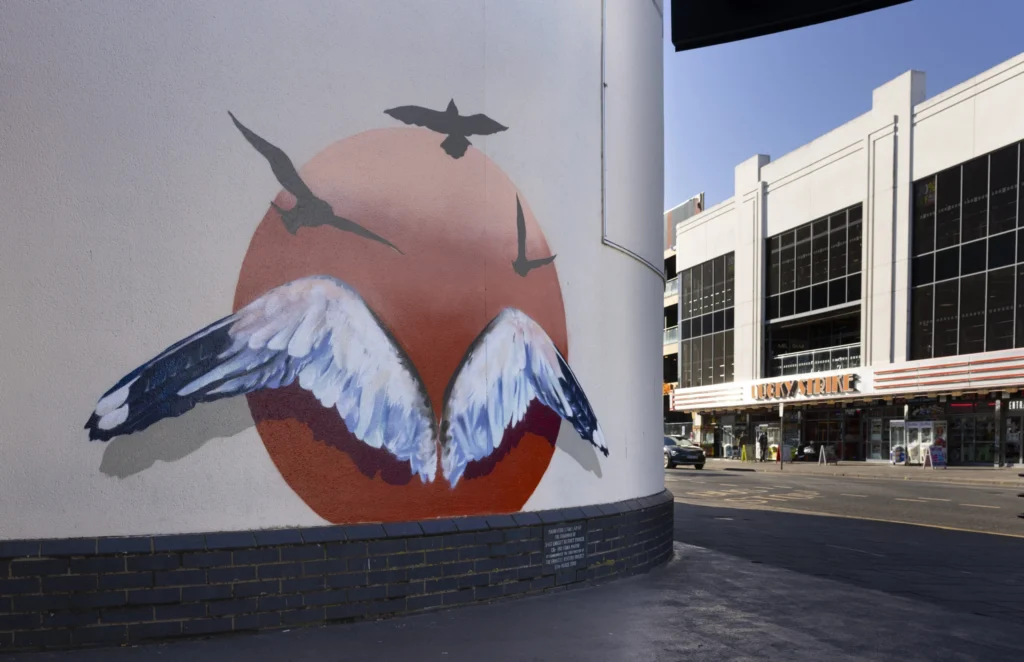

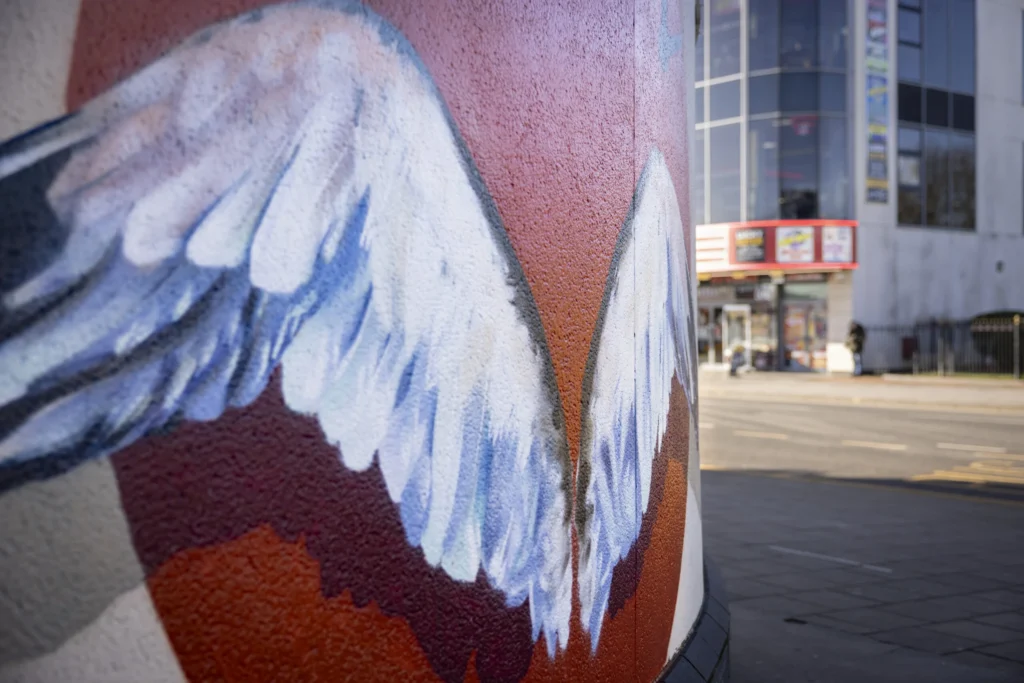
GULL in Skegness by Peachzz
Gull is located on the wall at the main entrance of the Embassy Theatre, Grand Parade, Skegness PE25 2UG
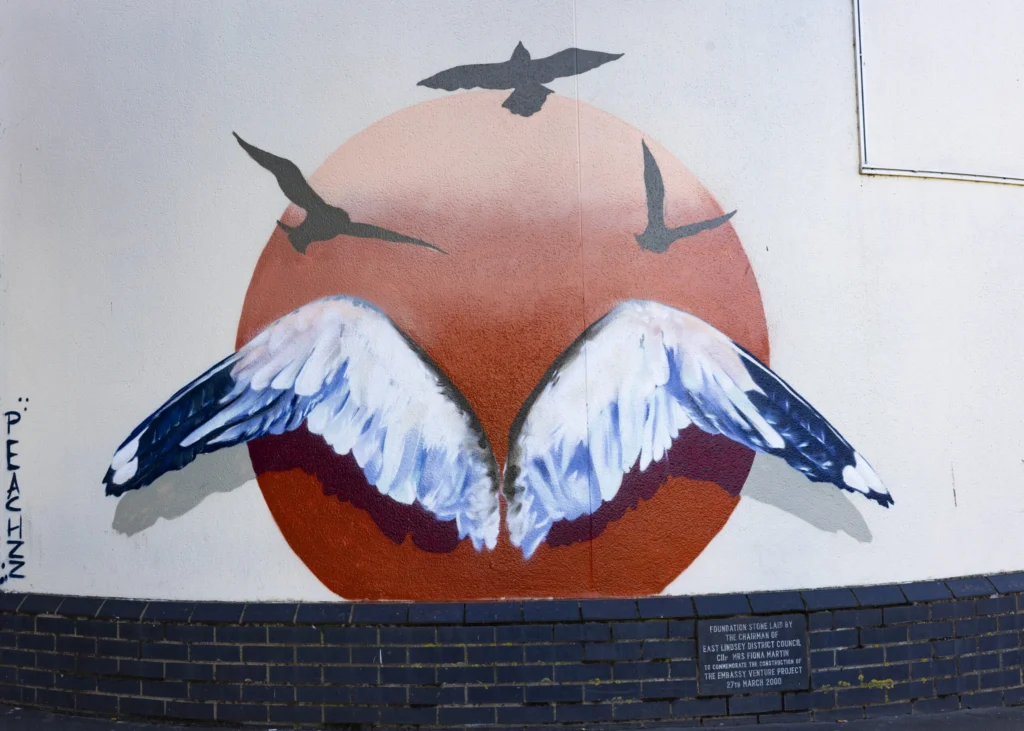
This artwork is a spray-painted pair of gull wings within a sunset and has been painted directly on to the walls of the Embassy Theatre.
There is more than one type of ‘seagull’ – in fact, there are around 50 species worldwide and six types which commonly breed in the UK.
This piece is inspired by the common gull and herring gull.
The herring gull is a familiar sight in our seaside towns, particularly during the breeding season, though some now nest well inland. In winter it can be found on farmland, wetland and coastal habitats, in landfill sites, playing fields, and reservoirs throughout the UK.
Despite its name, the common gull is not as common as some of our other gulls. It can be spotted breeding at the coast but is also partial to sports fields and housing estates in winter.
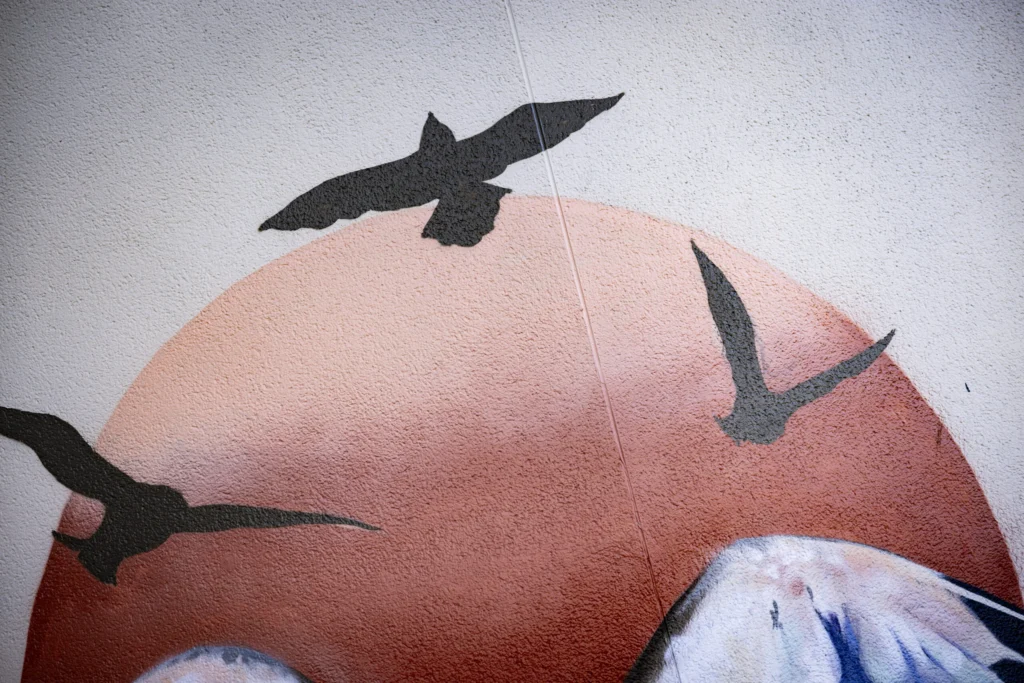
Here the gull wings can be seen against a beautiful sunset, with silhouettes of other gulls flying in the distance. It provides a stunning backdrop for photos!
It’s sited on the Embassy Theatre, which is located on the seafront of this hugely popular tourist resort. Hundreds of stars have performed at this renowned theatre, which hosts a wide range of events, and works closely with local communities and schools to create fantastic experiences for everyone.
There is a pay and display carpark directly behind the venue – please note this is accessed via a height restriction barrier at 2.05m. The car park is operated and maintained by East Lindsey District Council. For the latest charges and information for the Skegness area – click here for a map of their locations.

Peachzz found street art in the UK’s abandoned industries, allowing her to splash paint over forgotten walls. Her work typically looks at nature and life contrasting with the concrete structures of urban spaces. She is a confident painter of large-scale walls, with over ten years’ experience. Her style is expressive, with hints of realism all while experimenting with a bold colour palette.
Peachzz has travelled with her work all over Europe and has painted as far as the USA, Colombia & Mexico and has worked with people/companies such as UPS, NME, ITV, The British Council, Avanti West Coast & The Wildlife Trust and has recently won best street art in June 2024 with Street Art Cities. She was delighted to win this commission in Skegness, as she has been coming here on holidays since she was a child, and the town brings her very happy memories. She says:
‘I wanted to paint something that would capture the essence of these birds and what it means to be on the coast. I hope it will bring joy to those who pass by. Projects like this really create positivity towards arts especially if they are interactive!’
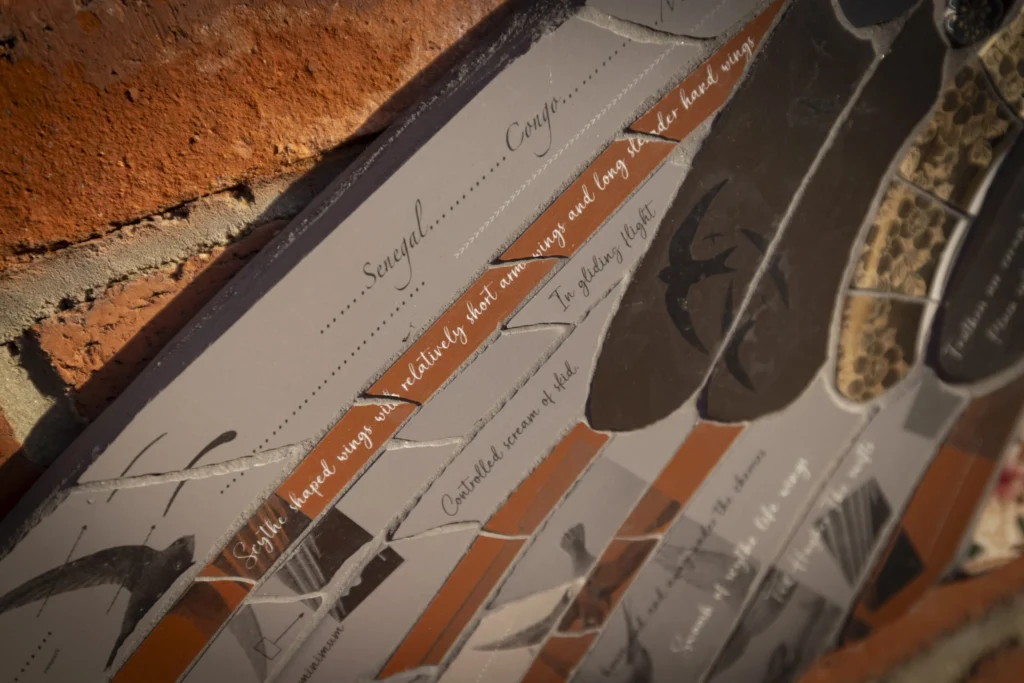
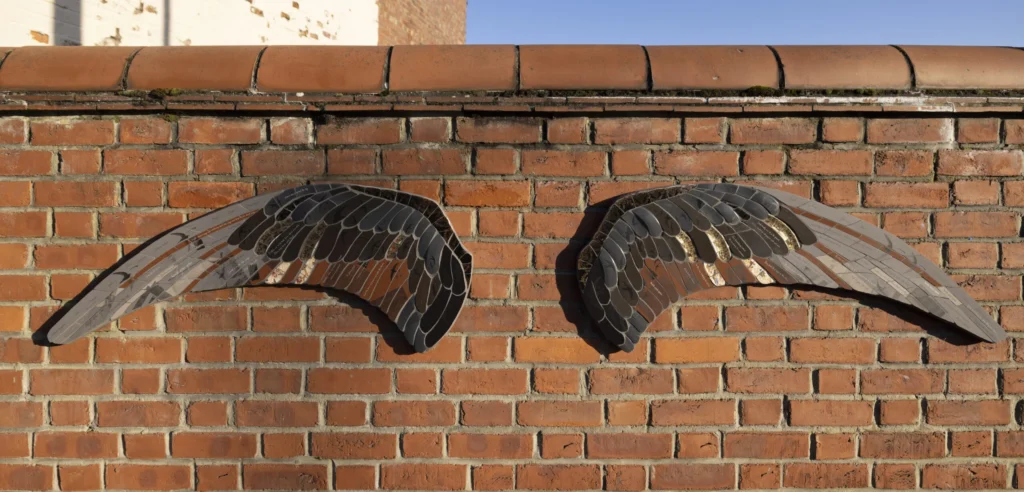
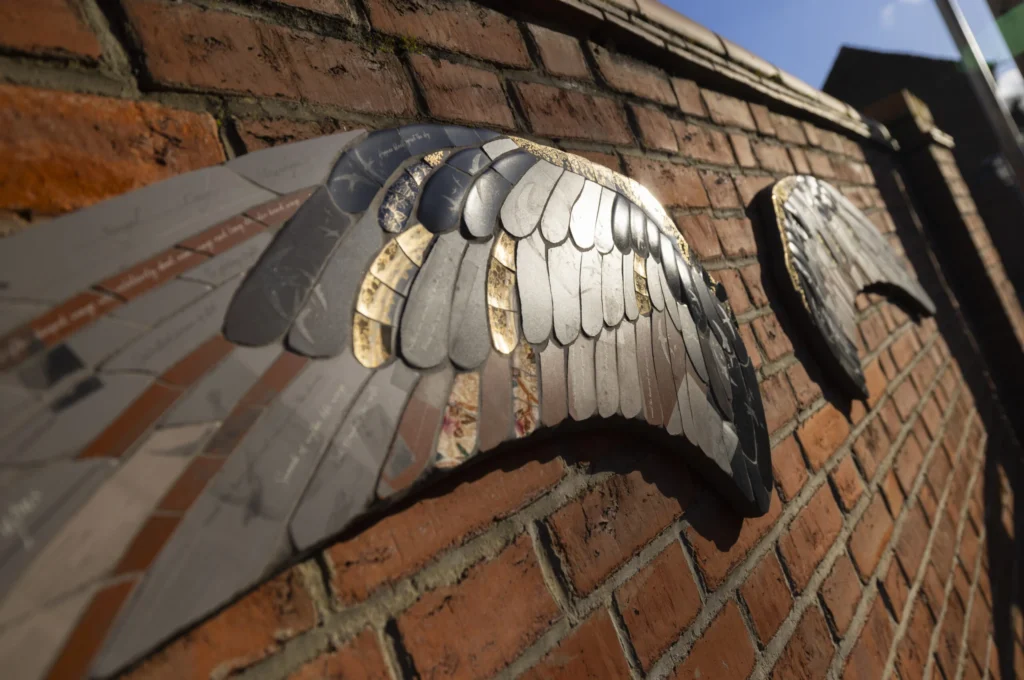
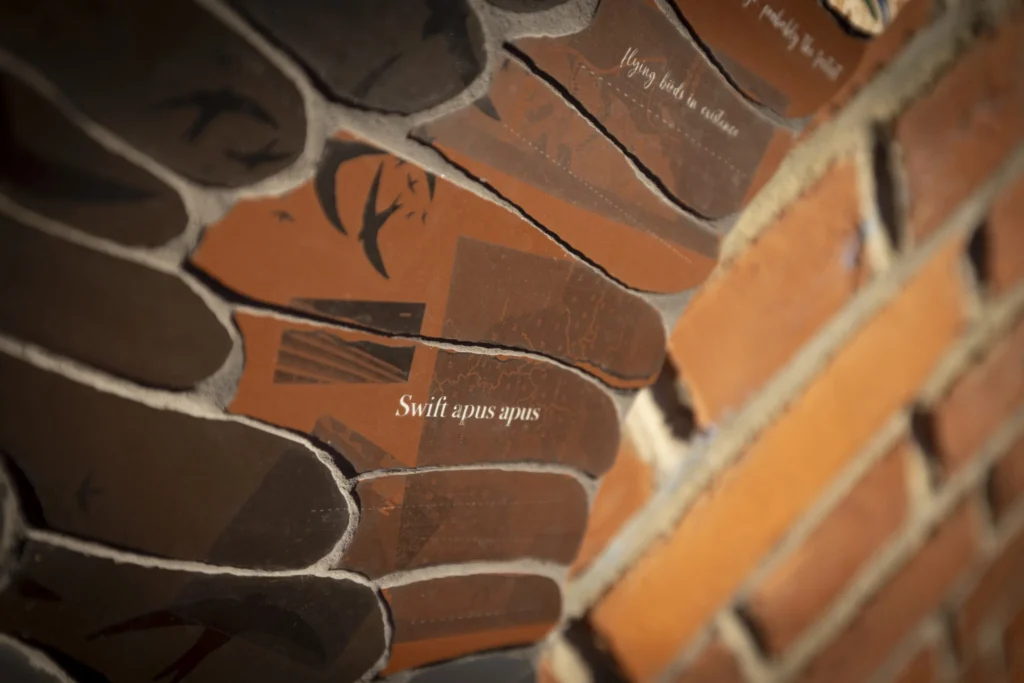

SWIFT in Wainfleet All Saints by Fiona Gurney (Box of Frogs Mosaics)
Located on the wall of the Co-op car park at 61 High Street, Wainfleet, PE24 4BN
This is a mosaic artwork, containing vintage pottery, plates and tiles, fixed to the wall.
This bird is special for Wainfleet, as the town continues to be chosen by swifts for breeding during the summer months. The beautiful old buildings in the town provide the perfect nesting sites – under roof tiles, in holes in eaves or soffits. Sadly, swifts are on the Red List of conservation concern, with populations declining by 62% between 1995 and 2021.
The swift is dark brown all over, often appearing black against the sky, with a small, pale patch on its throat. They’re larger than swallows and martins, with long curving wings that make them look a bit like a boomerang in the air. Swifts are very sociable and can often be spotted in groups wheeling over roofs and calling to each other with high-pitched screams.
Swifts are almost never seen perching. Sleeping, eating, bathing and even mating while flying, swifts rarely touch the ground. They are also the fastest birds in level flight, with an impressive top speed of 69mph.
Swifts are summer visitors to the UK. Spending their winters in Africa, swifts migrate 3,400 miles twice a year, stopping off to refuel in places like Portugal and France along the way to our shores.
The artist says, “I had to get to know the swift really well before I made any decisions about my design. Ornithology books were vital for the shape, colour, feathers, behaviour and migration. Once I felt I could see the birds in my head (as sadly there aren’t any where I live), I began collecting the sooty, mole brown ceramic plates and images to fire into their surfaces. This excerpt from the poem ‘Swifts’ by Ted Hughs, instantly conjured up the birds in my head:
They swat past, hard fletched
Veer on the hard air, toss up over the roof,
And are gone again.”
Wainfleet is an ancient port and market town on the east coast of Lincolnshire.
A great place for holidays just a few miles from Skegness and miles of sandy beaches.
Wainfleet stands on the Steeping River with the local section is known as the ‘Haven’, or safe harbour. Wainfleet is famous for he Magdalen College (now a museum and community library), Barkham Street and Batemans Brewery which supplies “Good Honest Ales” to Lincolnshire and beyond.
The artwork can be found on the wall adjacent to the entrance of the Co-op car park.
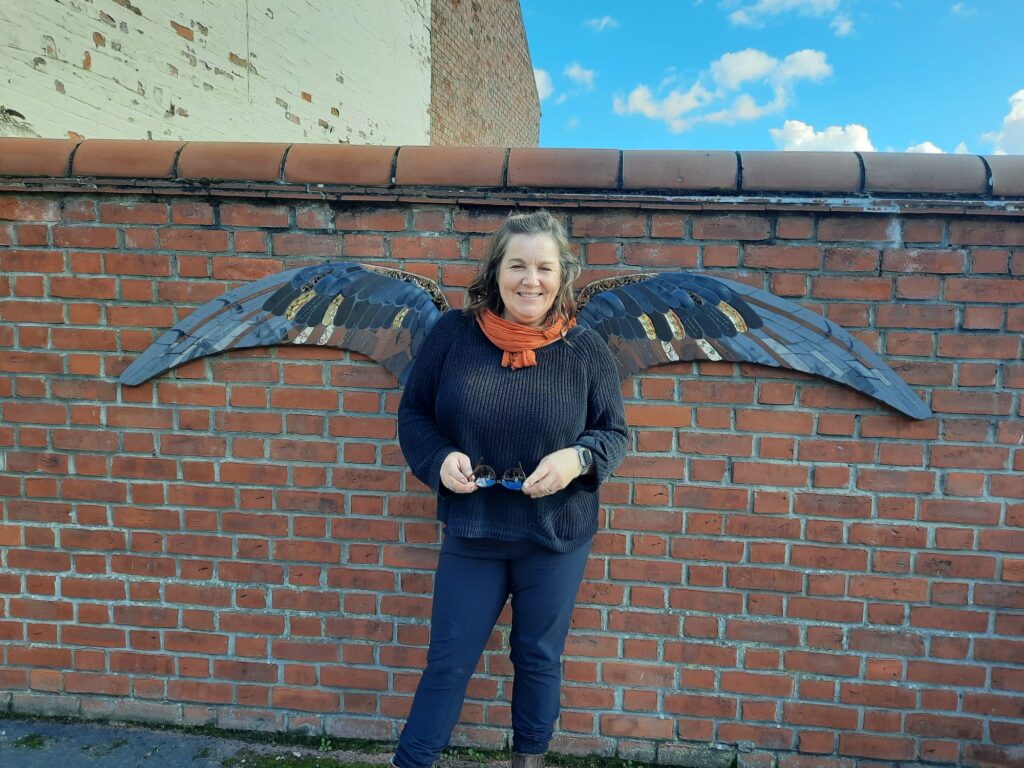
Although originally trained as a textile designer, Fiona Gurney has been creating patterns with recycled crockery and tiles to make contemporary mosaics for over 20 years.
Among many influences, she is drawn to the flora and fauna of the UK, mid-century ceramics and studio pottery, the collections of Enid Marx and Kettle’s Yard and to the language used to describe creatures and their environment.

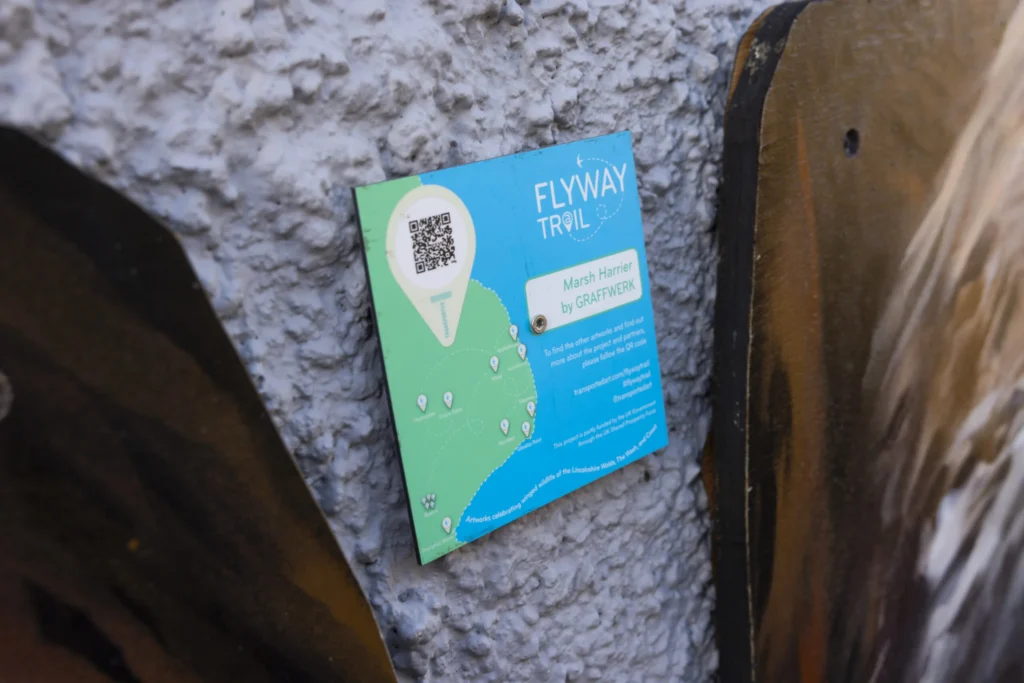

MARSH HARRIER in Mablethorpe by GRAFFWERK
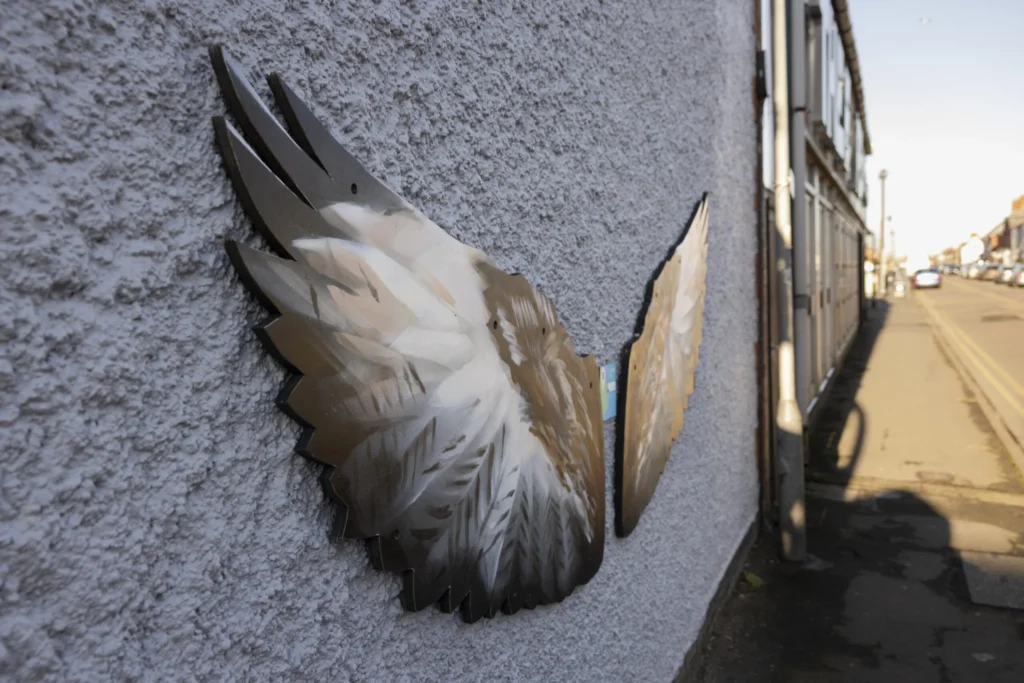
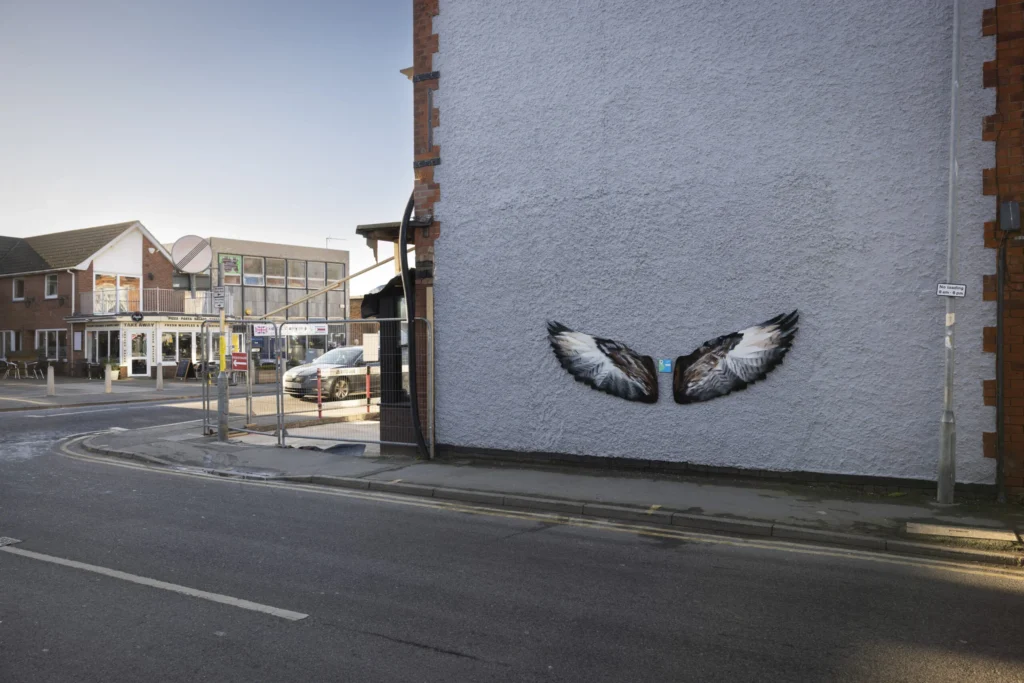
Located on the corner of High Street and Wellington Road, on the wall just before The Empire. 66 High Street, Mablethorpe LN12 1AS
This is a pair of painted marsh harrier wings on shaped marine ply panels fixed to the brick wall.
The marsh harrier nests in large reedbeds where it feeds on frogs, small mammals and birds.
Once very rare, it has recently spread from its stronghold in East Anglia to other parts of the country, like Lincolnshire, where its natural reedbed habitat is found.
Although the marsh harrier is typically a migrant bird, arriving here to breed in April and leaving in October to winter in Africa, an increasing number are choosing to overwinter in the UK.
During the breeding season, males perform amazing courtship displays, wheeling at great heights then diving towards the ground while performing a series of tumbles. Sometimes the female will join in, and they will lock talons mid-air.
Marsh harriers have a wingspan of up to 1.2m, roughly half the size of this artwork. The largest of the harriers, the species can be recognised by its long tail and light flight with wings held in a shallow ‘V’. It is distinguishable from other harriers by its larger size, heavier build, broader wings and absence of white on the rump as with the hen harrier. Females are larger than males and have obvious creamy heads.
Its future in the UK is now more secure than at any time during the last century, but historical declines and subsequent recovery means it is an Amber List species. Marsh harriers are a Schedule 1 listed bird on The Wildlife and Countryside Act.
Mablethorpe is in the East Lindsey district of the county of Lincolnshire in Great Britain. Located on the East Coast adjacent to the village of Sutton on Sea, Mablethorpe is between the popular seaside resorts of Cleethorpes and Skegness. An hour in each direction are the large conurbations of Lincoln, Boston and Grimsby.
The artwork can be found on the high street, on the corner to Wellington Road on a wall just before The Empire.
The team behind Graffwerk have grassroots backgrounds in the culture they support allowing them to deliver extensive engagement on a meaningful level.
As an artist team, they represent the culmination of years of independent and collaborative projects supporting the development of artists and musicians both locally and nationally. They have created three of the pieces on the Flyway Trail.
They said, ‘Our part of the project was very specific the design process, which was pretty straightforward really. We wanted to make the wings look as realistic and accurate as possible to demonstrate the species’ natural shape and plumage.’


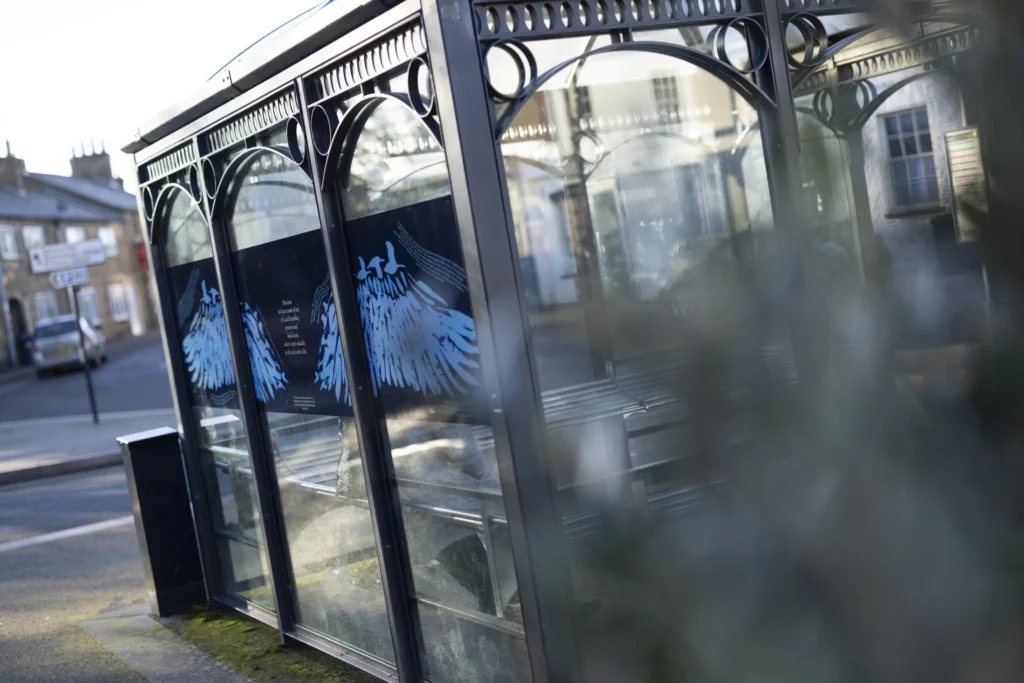
GOOSE in Alford by Less Sass
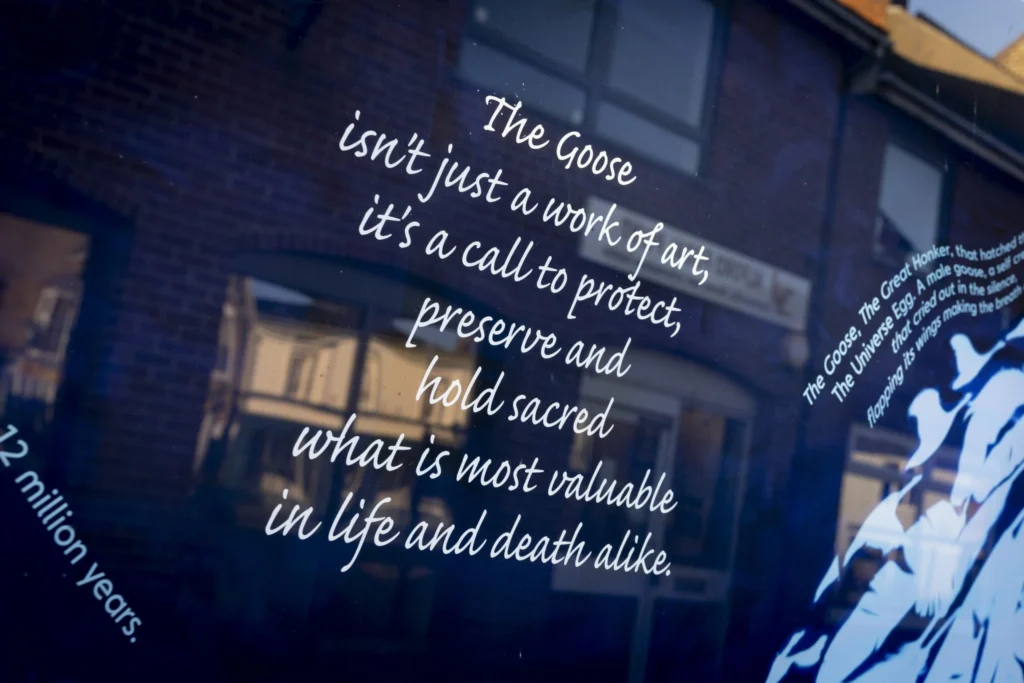
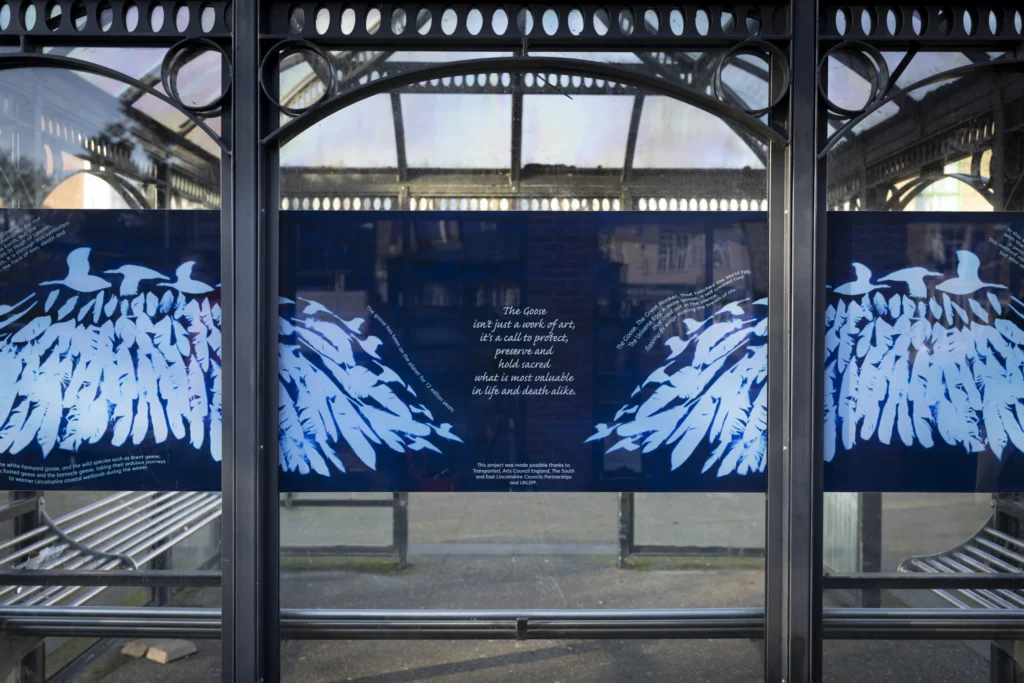
Located at the back of the bus shelter outside Alford Library & Focal Point, 6 South Market Place, Alford LN13 9AF
This is an enlarged digital print of an original cyanotype, a process that uses natural sunlight to create a printed photographic image.
For this piece, Lee has found goose feathers and combined these with words and paper cutouts to create the design. Cyanotype has become a signature element in much of Lee’s work. It’s a way of capturing moments, memories and meaning through simplicity, using light and natural objects to bring stories to life.
Lee began by reflecting on the birds that inhabit areas of Lincolnshire, exploring their symbolism and significance in storytelling. What do these birds represent? How do they connect with the land, with us, and with the stories we tell? Through this gentle yet intentional process, the artist invites the audience to see the world – and the creatures within it – through a lens of reflection, connecting art, nature and the human experience.
The goose is familiar figure, known from folk tales and fairy stories such as The Golden Goose, Mother Goose and The Goose Girl. It was perhaps the first bird to be domesticated, having been bred for eggs, meat and feathers for thousands of years. This artwork refers to both the white farmyard bird we know and love, and also to the wild species such as brent geese, pink-footed geese and barnacle geese, taking arduous journeys to ‘warmer’ Lincolnshire coastal wetlands during winter months.
Geese are often depicted as guardians and watchdogs in folklore and mythology, defending against chaos and evil spirits. They have a fiercely protective nature – for their loved ones and their territories. It is through this symbolism that this Goose takes on new meaning, standing as a protector in the face of ecological disaster; the destruction of natural habitats and increasing global temperatures, which are affecting the safety of traditional migration routes and patterns for many species.
Alford is a historic market town on the edge of the Lincolnshire Wolds and just 7 miles to the East Coast. Quiet and picturesque with good road links in all directions, Alford is a great base for exploring rural Lincolnshire.
In Alford, you can find lots of historic interest, with a working 5 sailed windmill, 17th century manor house and a 14th century church. The town hosts several craft markets each year, as well as a popular 1940s weekend and Christmas event.
An artist with deep roots in community-based work, often in challenging spaces, Lee Sass seeks to create art that speaks to the human experience. She works in a wide range of disciplines; specialising in enabling people to create meaningful and life enhancing work.
Lee became a celebrant after the death of her husband 20 years ago. Connected to this practice, the artist has recently begun making burial shrouds – creating beautiful works which are respectful to both the individual and to the earth.
Lee said, ‘This work invites engagement on multiple levels. For some, it’s a fun and creative activity, capturing a moment of joy and imagination. But for others, it becomes an opportunity to reflect on, in this case, themes of protection of the earth, nature, responsibility and life. It’s a reminder that true community art goes beyond surface-level fun. It should be accessible to everyone, while also offering depth, connection, and the potential for personal reflection.
By offering multiple entry points, this piece encourages a broad spectrum of engagement—whether it’s through a playful pose or a deeper, more profound exploration of what it means to become “more than.” That’s what community art should be about: creating space for all, while fostering moments of meaning and connection.’
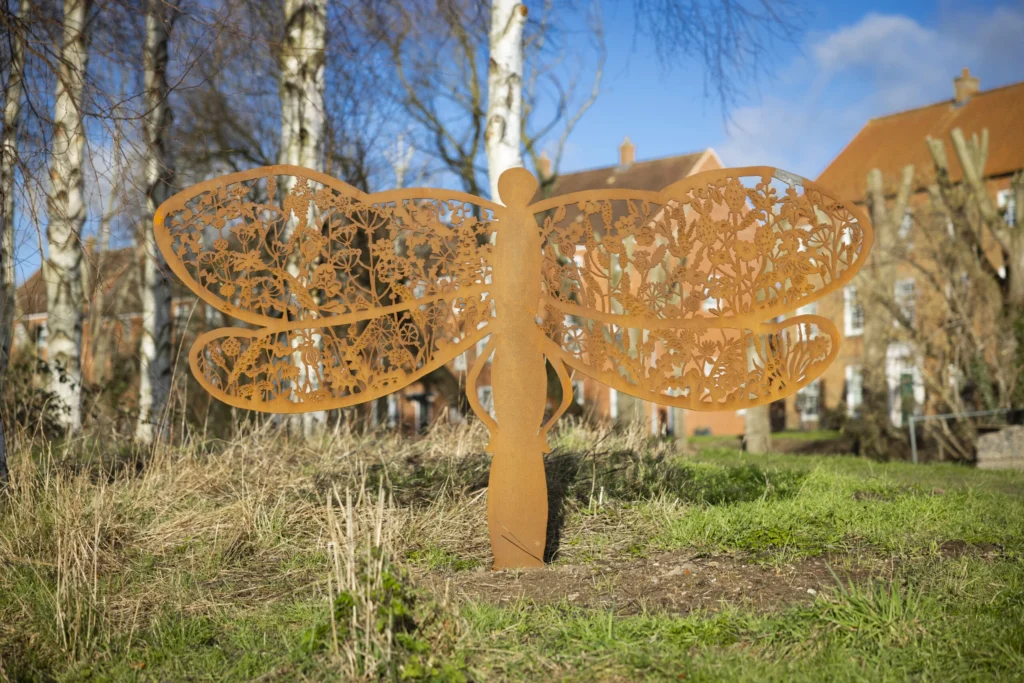

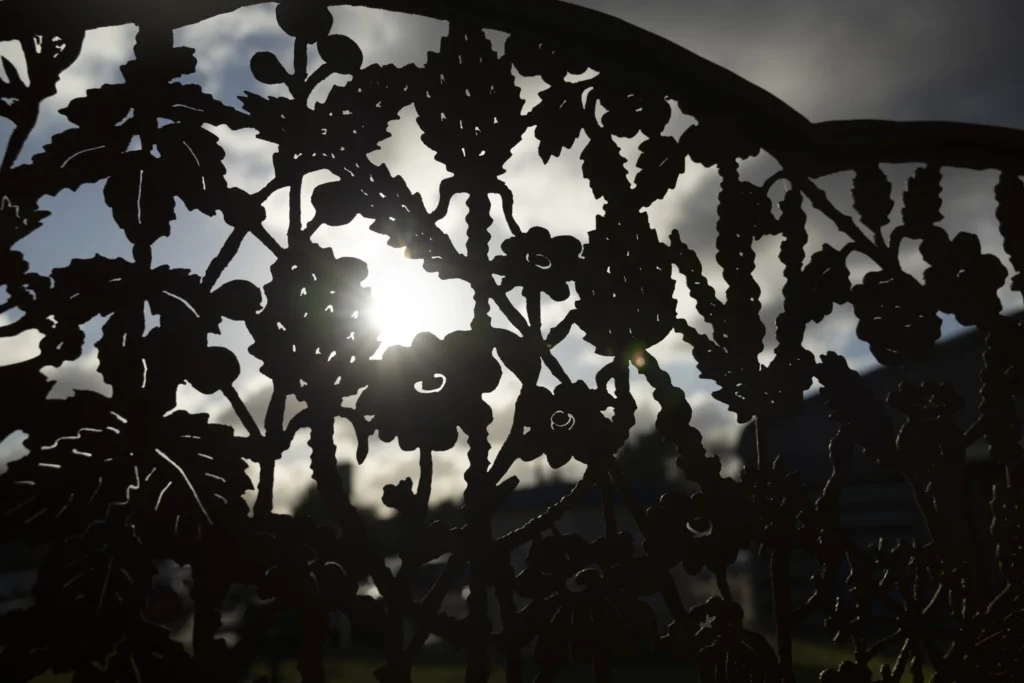
DRAGONFLY in Horncastle by Jeni Cairns
This artwork is located towards the back of the grassy area next to the River Bain. Tesco, Water Mill Road, Horncastle LN9 5DR
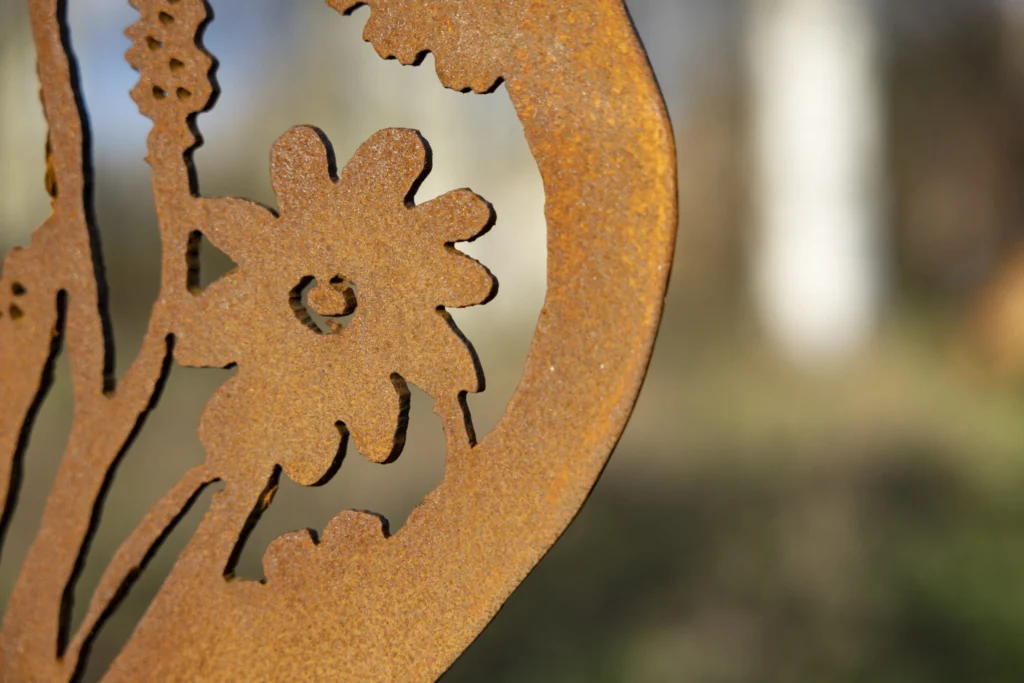
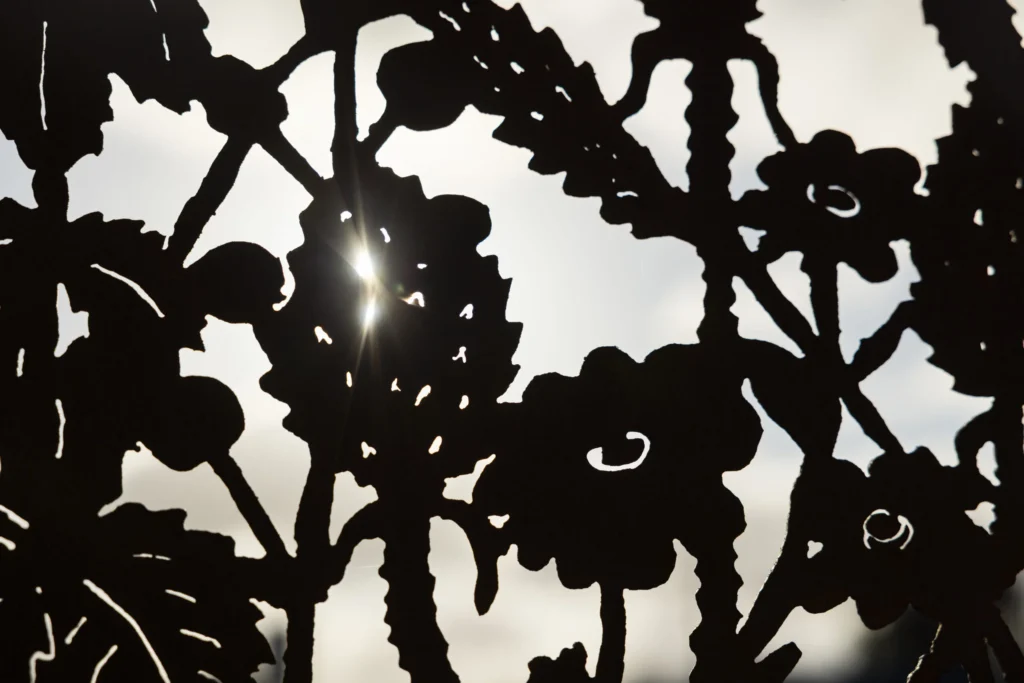
This is a freestanding metal dragonfly sculpture, laser cut with species of wildflowers including wild carrot, clover, oxeye daisy, mugwort, plantain, dandelion, wild rose, oat, grasses, reeds, wild mustard, dock, nettle and burdock.
Lincolnshire’s chalk streams are a characteristic and attractive feature that has helped shape the Lincolnshire Wolds landscape over the past 10,000 years.
Rain that falls on the Wolds is filtered through the underlying chalk aquifer which soaks up and holds rainwater – a bit like a sponge. Water then moves through cracks in the chalk and emerges at ground level, from springs and blow wells, crystal clear and with a constant temperature of 10°C.
These typical characteristics make them ideal to provide drinking water to many and are home to some of the most rare and threatened plants and animals, such as water crowfoot, water vole, otter, European eel and brown trout, as well as supporting many other species including dragonflies and the types of wild plants featured within the artwork along their banks.
The chalk streams, wonderfully wild and pure in nature, provide wildlife corridors linking the Wolds and the Fens.
Chalk streams are ours to enjoy, and ours alone to protect. However, 77% of chalk streams are failing nationally, including the River Bain and River Waring in Horncastle.
Over the next two years, the riverscape in Horncastle will transform with improvements to increase biodiversity and wildlife.
The artwork can be found adjacent to the Tesco car park, towards the back of the grassy area next to the River Bain.
Jeni Cairns is an award-winning artist and garden designer living in rural Cambridgeshire. Her work covers a wide variety of mediums and disciplines including metal work, painting, collage, sculpture, drawing, garden design and planting. She studied Art & Design at Isle of Ely college and Fine Art at Derby University.
Jeni has said of this approach, ‘Working in response to the nature that surrounds me, I create sculptures that capture the quality of delicacy of nature but also its hopeful resilience. I hope my pieces will connect people a bit more to the wonder of nature and thus help to develop love and care for our natural world’.

SHORT-EARED OWL at National Trust Sandilands by Emily Bowers
Located on temporary hoardings near to the cafe at National Trust Sandilands, off the A52 coast road, LN12 2SE
This is pair of short-eared owl wings, painted onto shaped marine ply panels and fixed to the temporary hoardings.
Short-eared owls are medium sized owls with mottled brown bodies, pale under-wings and yellow eyes. They are often seen hunting during the day. In winter, there’s an influx of continental birds (from Scandinavia, Russia, and Iceland) to northern, eastern, and parts of central southern England, especially around the coast.
They are of European conservation concern and so are an Amber List species.
This species has become an iconic bird at Sandilands, often spotted flying low along the grassland, searching for prey.
The National Trust is embarking on an exciting project to transform the former golf course at Sandilands into a year-round nature experience for everyone.
Working in partnership with the Lincolnshire Coastal Country Park, they will create new habitats for a variety of wildlife, especially migrating birds such as black-tailed godwit, spotted redshank and spoonbills, and breeding birds including snipe, lapwings and oystercatchers.
Their vision for this new reserve is to provide a space where everyone can enjoy the benefits of being in nature.
The National Trust Sandilands team said, ‘We’re delighted to have this opportunity as the Lincolnshire coast is one of the most important stretches of the English coastline for wildlife as a stop-over on the ‘flyway’ migration route. We plan to create an amazing place for people to immerse themselves in nature and truly connect with the wonders the Lincolnshire coast has to offer.’
As part of the creative programme of activities connected to the Flyway Trail project, in early September, Emily delivered a free workshop in Boston’s Market Place where she guided participants in creating colourful artworks inspired by birds and their habitats.
Of the project, Emily said, ‘It’s really exciting to be part of the project. I grew up in the area so to be one of the selected artists and have my artwork in the trail is really cool. Nature is my main source of inspiration too and I adore birds. A blend of nature and creativity is always an exciting space to forge new connections with the natural world which we are very much part of.’


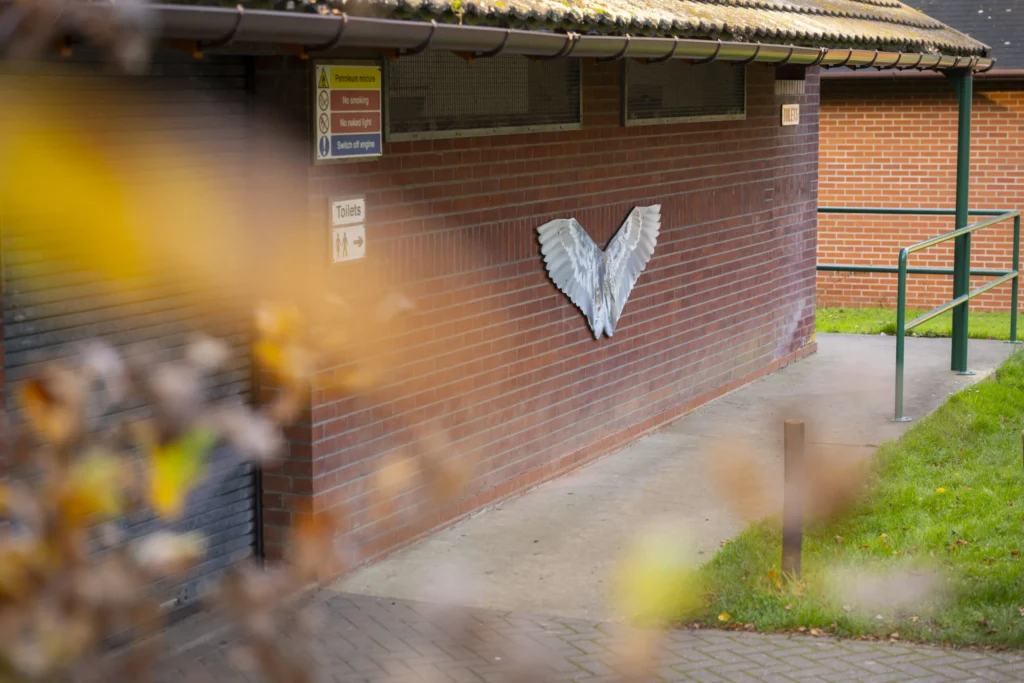
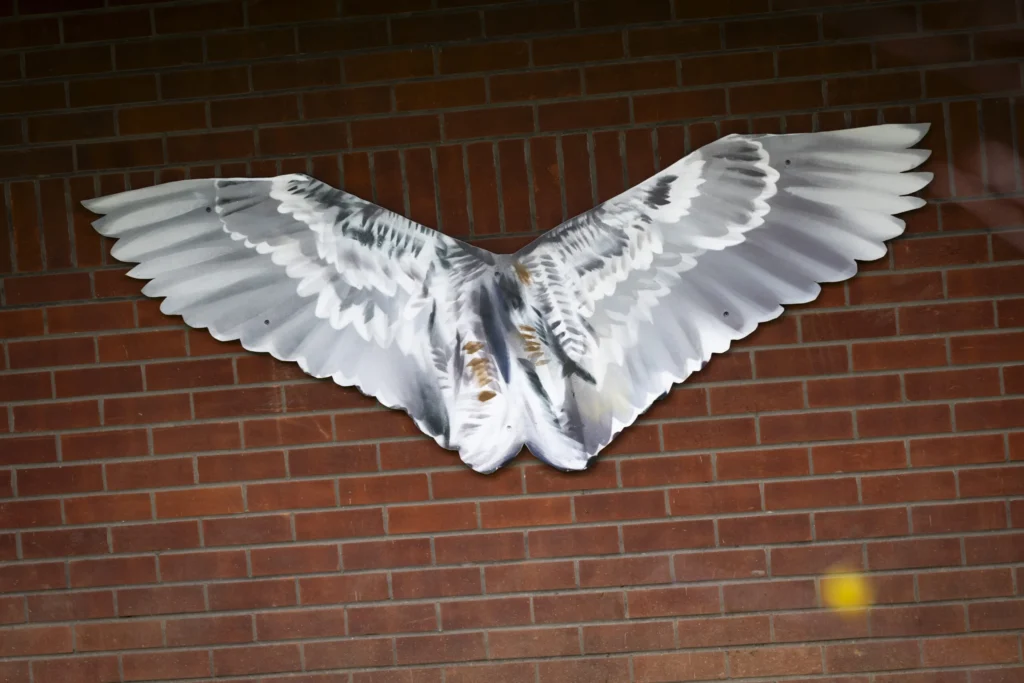

COMMON SNIPE at Snipe Dales Country Park by GRAFFWERK
Located on the wall of the public toilet building, Snipe Dales Country Park, off the B1195, Spilsby, PE23 4JB
This is a pair of common snipe wings, painted onto shaped marine plywood panels, fixed to the wall.
A medium-sized wader, the snipe lives in marshes, wet grassland and moorlands, where it nests in simple scrapes.
It uses its long, probing bill to find insects, earthworms and crustaceans in the mud, typically swallowing prey whole. During the breeding season, males make a unique ‘drumming’ sound as their tail feathers vibrate in the wind as they perform their aerial courtship displays.
This sound, which would have been common at Snipe Dales for centuries, is no longer heard as the species has sadly stopped breeding here.
The attractive valleys of Snipe Dales, fretted by streams, offer wonderful views of the southern Lincolnshire Wolds. The Nature Reserve has one of the few surviving semi-natural wet valley systems, while the Country Park offers mixed woodland walks. This diversity supports a wide range of birds and other wildlife including butterflies and dragonflies. The wetland valleys providing safe breeding grounds for the Common Snipe for centuries, which gave the area its name. However, sadly, Snipe no longer mate in Lincolnshire.
The woodland habitat of Snipe Dales Country Park is chiefly Corsican pine, planted in 1965 with a few Scots pine, beech and other deciduous trees. The pines are being slowly replaced with ash, oak, alder and other native broadleaved species. During the nesting season the woods are alive with bird song.
Many species can be found at the reservice, including treecreeper, goldcrest, wren, long-tailed tit and great spotted woodpecker. Tawny owls and barn owls, sparrowhawk and kestrel can often be seen hunting or watching for their prey.
The car park barrier is open from 8.30am to 5pm. There is a £1 charge for car parking at Snipe Dales. Ticket machines are cash only.
There are three different walking routes and public toilets, as well as picnic facilities. Dogs are permitted on a short lead in the Country Park (but not allowed at the Nature Reserve).
Graffwerk is a multifaceted arts project team comprising of Anthony Overend and Izzy Peacock. Focused on aerosol art Graffwerk has the aim of redefining the visual landscape of cities through the use of street art. They have created three of the pieces on the Flyway Trail.
They said, ‘We hope the finished project will help open people’s eyes to some of the amazing wildlife that exists in their area and encourages them to get out and discover more both locally and further afield.’
download the flyway trail map here
Designed by Lincolnshire-based designer CLR Studios, download the trail map or pick up a physical copy from some of the artwork locations such as Gibraltar Point and Frampton Marsh, and various landmarks and visitor destinations in Boston.
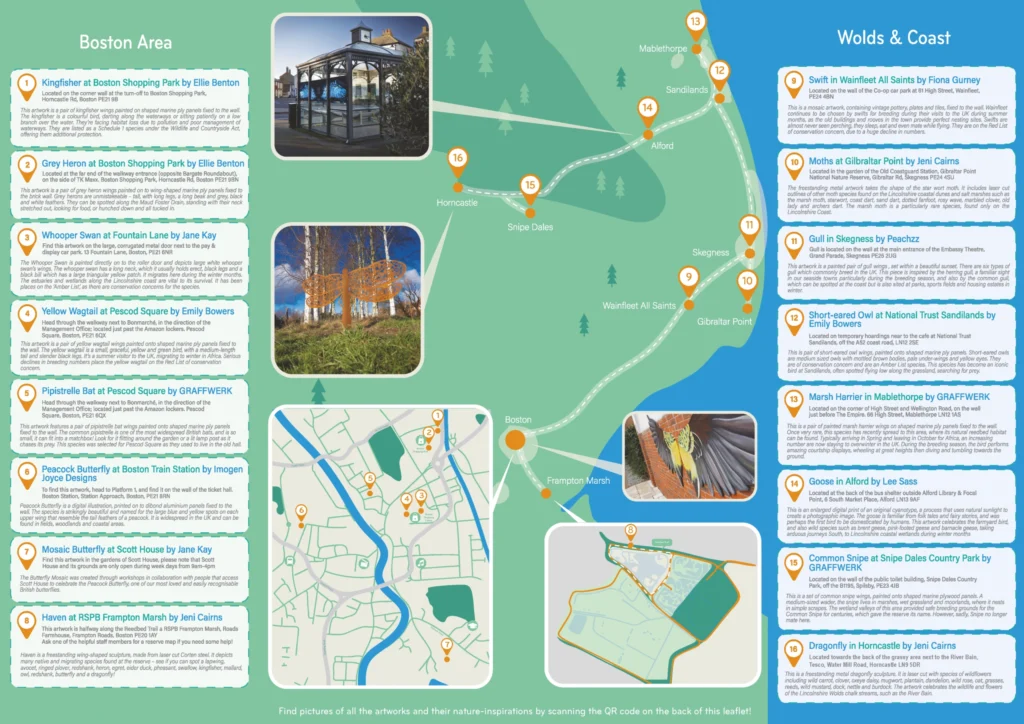
The Flyway Trail aims to deepen public awareness of RSPB and Wildlife Trust nature reserves Frampton Marsh, Freiston Shore, Gibraltar Point and the region’s natural heritage, encouraging physical activity and longer visits to the area. It seeks to foster a stronger connection between people and nature, promoting responsible stewardship of our environment.
The Boston part of the trail encourages visitors to RSPB Frampton Marsh to extend their visit into the town centre (and vice versa), while the East Lindsey section provides a range of recreational days-out linking to local visitor offer. It creates ‘flyways’ for those travelling to different artwork sites through their own journeys of exploration!
The project was conceived in consultation with the Boston Residents Mural Group, a voluntary steering committee dedicated to enhancing public art in Boston and fostering community pride.
The project is possible thanks to Transported, Arts Council England, Boston Borough Council, East Lindsey District Council, the South and East Lincolnshire Councils Partnership and UKSPF funding.